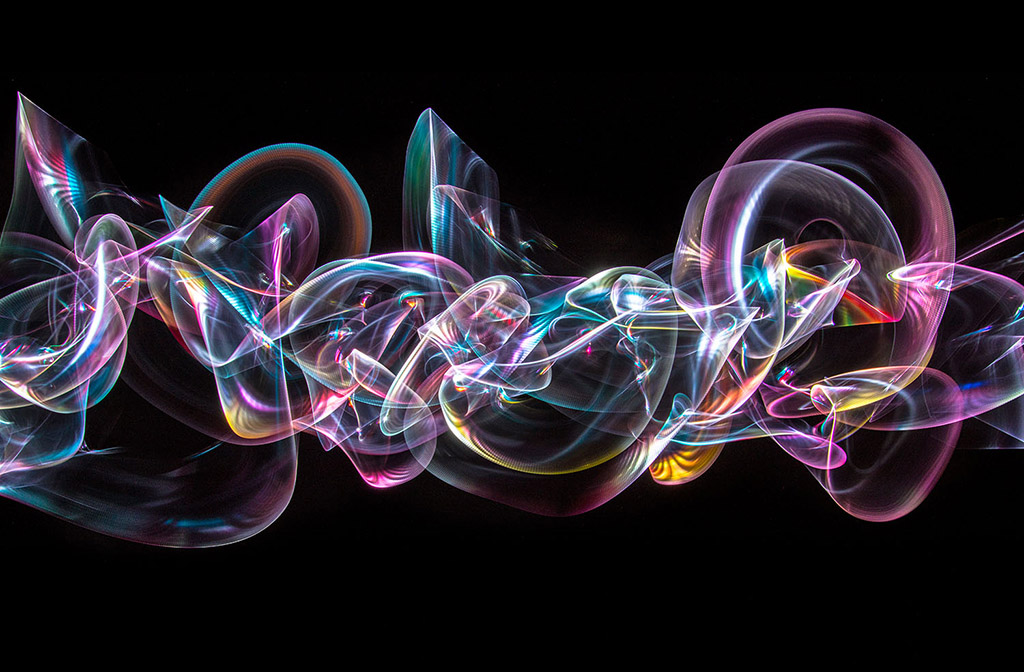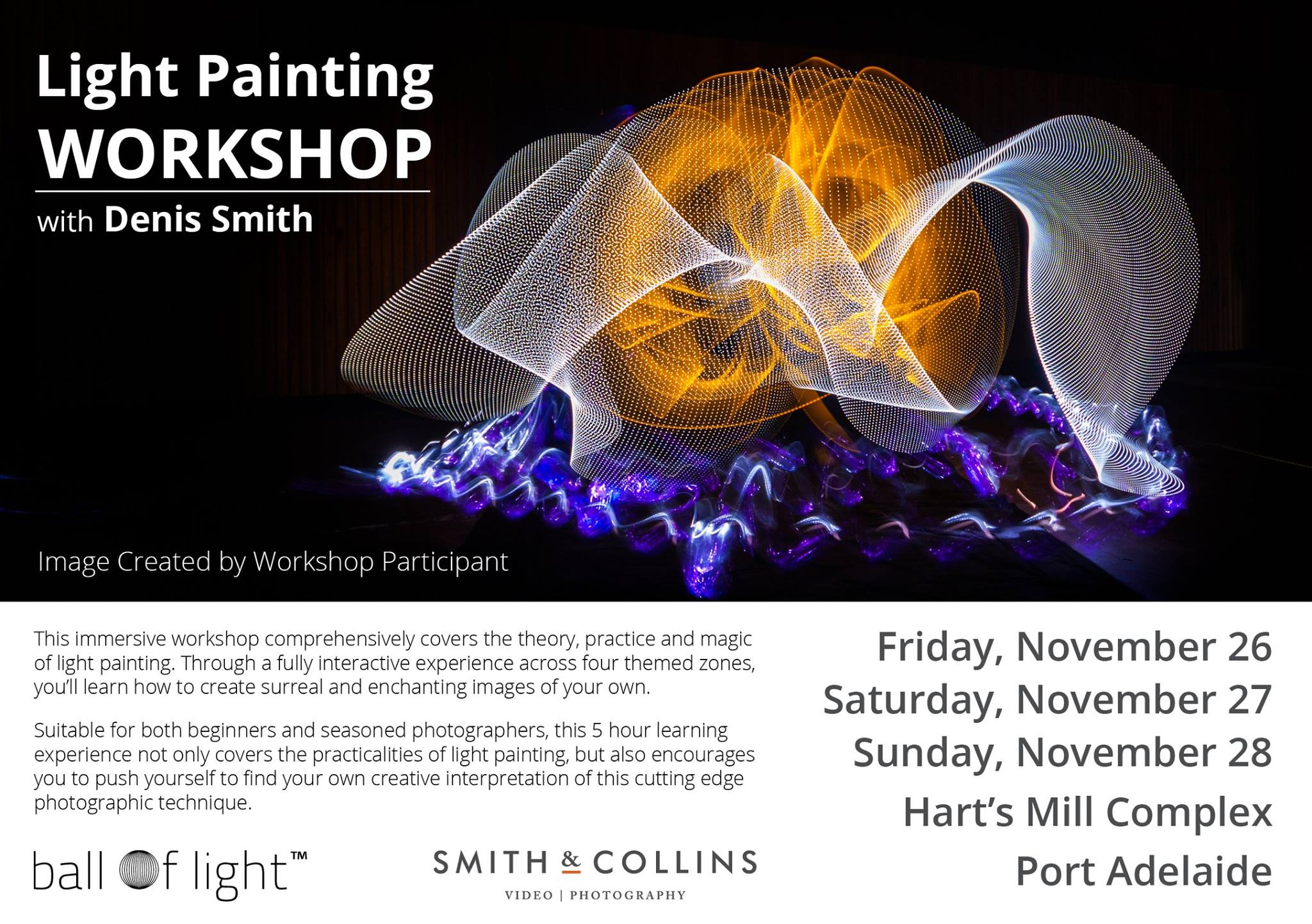
I have never been to one of Denis Smith’s Light Painting workshops but from what I have seen and read it looks like the man puts on one of the best workshops in the business. From awesome locations and gear for everyone to use, all the way down to the food service, the events look like one incredible experience. Good news is he has a new one coming up this month! Check out the video below for a taste of what to expect and head over to http://www.smithandcollins.com/workshops/ for all the details.
Light Painting Tutorial: Spirographs and Physiograms
This light painting photography tutorial shows how to create a light painting spirograph or physiograms using tools from the Light Painting Brushes system. Spirograph are complex looking light painting that are really easy to create. This is a great project for people just starting out with light painting, also a excellent project for teachers that are interested in sharing the light painting art form with their students. Spirographs are fun and easy to make.
Check out these other light painting video tutorials!
Electric Orb: https://vimeo.com/121148809
Empty Plastic Bottles as Custom Light Painting Tools: https://vimeo.com/107518090
Become involved in the Light Painting Brushes Movement!
On Instagram @LightPaintingBrushes #LightPaintingBrushes
http://instagram.com/lightpaintingbrushes
http://facebook.com/lightpaintingbrushes
http://twitter.com/LPBrushes
Patrick Rochon’s new Light Painting Kata’s
Patrick Rochon’s new Light Painting Kata’s are so beautiful they might make your eyes bleed. Seriously these new Light Paintings are stunning. The mix of color and free flow form captures light in exquisite beauty. This new work is just the tip of the iceberg in what Patrick has going on including a new website and signing with an agency that is sure to bring Patrick even more well deserved success! Check out the video and read on of all the details.
Video by Pierre Tremblay, Listo films http://www.listofilms.com
Music by APigeon http://apigeon.bandcamp.com
LPP ∇ Hi Patrick, your new Light Painting Kata’s are really beautiful! To me they feel like there is some emotion and meaning behind them, can you tell me what the Light Painting Kata’s mean to you?
PR ∇ The LP kata has a personal and professional importance to me. It is a practice, an
exploration and discipline I’ve integrated in my life. The Kata is where I learn about myself and the art of light painting. This freestyle practice is transformative, it allows for non-control to take place, so in other terms, for intuition and instinct to grow. It gets you in a space of “feeling” the creation. In a way the kata is my teacher.

LPP ∇ How did these images come about?
PR ∇ The creative process is fascinating for me. Why one day it works like a charm and other days, well no much comes out. Same person, same tools, but it seems like every moment has its gifts and disappointments.
Well when you observe yourself carefully, internally and see what comes out, you start to see how feelings, emotions and results are all connected. It’s like the guts and heard transmits as much data has the brain. So after a while observing, you can piece it altogether and “see” the process taking place like an internal map. You know when it’s time to push, time to rest and step back or time to change direction.
So, I practice a lot and disregard many images. All the images are part of the growing process, of the trail we take to get there so they are all important, but I only share the special ones, the peaks. The only goal is practice often and regularly. Switching to process orientation and away from result orientation. Through time you see yourself evolving with, it’s like your body learns automatically so all you have to do is show up and create the moment you are living, good or bad. That’s how these images came to be, process.

LPP ∇ I knew there was something deep going on with these… What is the vibe when you are making the Katas? Is it in silence or do you listen to music when you are creating them, if so what is it?
PR ∇ I do and right now I often let Soundcloud to the choice for me, it often goes into
good shuffle directions. Here is a link of a mix I like: Nickodemus Robot Heart

LPP ∇ What you are using to make them and how you are getting those incredible colors?
PR ∇ I always use my Liteblades to do the katas. It gives the result I’m looking for, it inspires me to improve the tools and explore other possibilities. I play and modify the tools with tape, filters, textures… The tips are open so light comes through the front end so it gives me the options of adding different colours there and by using those and irises with black tape to control the quantity of light, it can create high lights and explosions when pointed to the lens.
I research my colours and find good combinations. I work with Lee and Rosco gels. I love the sample packs, they help a lot to find many variations of colours. Right now I work with prototypes that are bigger, it gives the impression of the light sword.
LPP ∇ Is there a feeling you hope people will have when they are viewing these images?
PR ∇ I think it’s personal. Everyone will feel different or see these differently. I hope people take time to be absorbed by the light in my images, taking time instead of zapping through, to become fascinated once again like a child, being sensitive to layers of their own imagination and inner selves.

LPP ∇ There have been some big changes in your life with your new website, which looks fantastic, and you have recently signed with a new Agency, Can you tell me more about that?
PR ∇ It’s been busy, I’m always seeking the next step and pushing myself further in my own process. It’s like a journey without a map where you need to trust your own feelings to get to places you didn’t expect.
When I met the agency Suzy Johnston & Associates a few years ago, I was impressed by the level of professionalism and consideration they had towards the other. But unfortunately, they rarely integrate new talents such as myself so we kept a good contact and I emailed them my work once in a while. After doing the Inspired Light project with Infiniti in Dubai, and while I was still dealing with the show in Saudi Arabia, my partner and I need support for negotiations and putting the right elements in place. I reached out to the agency and proposed a collaboration.
This collaboration allowed us to work together and gave us the chance to start a professional relationship. Since the connection, the chemistry and the flow was right, they offered to integrate me in the agency as one of their talents. So, we did the launch and announcement it in September.
I have to say, being surrounded by great professional people, is very inspiring and I feel the influence adding to my experience and knowledge. Of course soon after they asked me to create a new website to enhance and represent my work better. The older site didn’t give an overall view of what I do. It was hard to see my work for the people visiting, so many clicks and to much digging to get it… So, it took a period of three months to accomplish this new site, from searching platforms and templates to re-sizing and enhancing over two hundred images plus combining the shop, the blog, galleries and the choosing the artistic direction of it all….
LPP ∇ With everything I am seeing it feels like you have gone through a bit of a metamorphosis, is this limited to your website or is this in your Light Painting work and/or personally as well?
PR ∇ All is connected, the changes are affecting every part of your life, of my life. Change is everywhere right now, that’s what I’m seeing and feeling.

LPP ∇ One last question; What is the one person, place, or thing that you would really love to light paint?
PR ∇ Good question, I’ll get back to you with a result. 😉
LPP ∇ Congrats again on everything and signing with Suzy Johnston! I hope your success continues and grows my friend.
PR ∇ Thank you.
Peter Solness, Sharing Light in a Field Of Orbs
Light Painting Artist Peter Solness has started to take his Light Painting in much more public and inclusive direction. Thats not to say that he has moved on from the Illuminated Landscapes he is known for but this light painting work is a long way from the solitary action our art form can sometimes be. Peter has started creating large scale light paintings in public spaces, sharing the art form with people that have little to no experience with Light Painting. The results are pretty amazing! Check out the video and images, and read on to find out all the details in the interview below…
LPP ∇ Hi Peter I am really enjoying with your new Group Light Paintings in Public Spaces but before we get into that can you tell me a little more about yourself, specifically your background with photography and Light Painting?
PS ∇ I bought my first serious camera as a 16 year-old schoolboy way back in 1974. It was a Nikonos II underwater camera and I used to swim out at popular surfing locations and shoot from the water.
Surfing photography was a good teacher. I learnt that getting a good surfing image took a lot of planning, travelling, determination and good luck. At one stage I began to experiment with shooting surfers at night. I attached a waterproof flashgun to my Nikonos II and set up night surfing sessions with local surfers. It was a crazy thing to be doing, floating around in a dark ocean being smashed by inky-black waves, but the reward for such extreme photo sessions was capturing something completely different from your everyday photo (not unlike the pleasure I get when doing my light paintings today).
The results of my night surfing photos were finally published in 1977. It was the first ever feature article about night surfing and there was a real fascination about the photos at the time.
From 1980 to about 2005 I followed my dream of working as a photojournalist. I shot assignments for many magazine, newspaper and corporate annual reports both in Australia and internationally. It was a great experience.
During this time I had a number of opportunities to experiment with long exposure photography and light painting techniques. For example in 1980 I worked at an underground mine in outback Australia. A photographer there showed me how to light-up huge black spaces where ore had been extracted during the mining process. He would walk around with a Metz 60 flashgun and light paint these pitch-black chambers using up to 50 separate flashes during a long exposure. The result of all that accumulated exposure made the space look as bright as daytime. I began using that technique on numerous industrial photography assignments over the years.
Around 2005 I noticed things were really starting to change in the photography business. I realised my livelihood as a photojournalist was coming to an end, as newspapers and magazines started cutting back on budgets and sacking staff photographers. I was frustrated that I had so many skills but was not able to use them anymore. I was in my mid 40’s and I wanted to keep doing interesting photography so I started to dabble more in light painting.
I began using a mini-Maglite to draw outlines of historic Aboriginal engraving sites carved into sandstone rocks near where I live in Sydney. I realised that light painting made it possible to reinterpret a place in a very particular and unique way.
In 2009 I then started applying torchlight to trees and rocks and sought to create mysteriously beautiful images of the Australian landscape by blending torchlight with ambient moonlight. From this series I began to build a new website called Illuminated Landscape www.illuminated-landscape.com which has been very successful.
The photos from the Illuminated Landscape series sold well as fine art prints to both private and public collectors and I won several prestigious landscape photography awards. Through this period I also began to run light-painting workshops. I have since taught hundreds of photographers the art of light painting and it has been a thrill to inspire so many people.
LPP ∇ The group light paintings that you have been creating are absolutely incredible, was the ‘Field or Orbs’ your first Group Light Painting?
PS ∇ The ‘Field of Orbs’ wasn’t my first group light painting event, but it has been my most ambitious and successful.
The Field of Orbs was very special as I conceived the idea from the start and kept total control over how it should be created and what sort of outcomes I wanted to achieve. It is very thrilling to see something that existed in your imagination come to life so publicly and with such energy and enthusiasm. It also allowed me to set a new benchmark for the way light painting can be used for public enjoyment. I especially want to acknowledge the amazing orb images of the East Coast Light Painters and Andrew Wells whose work provided the original inspiration for this event.
Previously in 2009 I did a large-scale light painted image as a global environmental art project to promote the 350.org climate change movement. I directed 150 people holding glowing lanterns to walk around a marked pathway over a 45 second exposure period to create the number 350. The image was very successful and is still used as a key graphic on the 350.org home page seven years later.
LPP ∇ Were the participants of the Field of Orbs project part of a photography club or something like that or were they just random people interested in making art?
PS ∇ The Field of Orbs was created to celebrate the International Year of Light and I received support from government agencies wanting to get the general public involved in the celebrations. I realised that having 100 volunteers spinning orbs would be a great way to get people from all sorts of backgrounds excited about creating public art and experiencing the magic of light painting. So we listed the event with an online booking agency called Eventbrite and within days the event was fully subscribed. The organizers actually had to stop promoting the event, as they were worried about the crowd becoming too big to handle.
LPP ∇ Woah, so how many people were involved?
PS ∇ In the end we had 100 orb spinners, 200 photographers and around another 200 spectators. I think a lot of the photographers came from Meetup website groups and camera clubs who had read about the event in the promotional publicity and realised that it would be a unique event to photograph.
LPP ∇ How did you get that many people to participate let alone actually understand what they were doing?
PS ∇ As this was a public art event I was very interested in the public participation aspects of the event, rather than just getting a great photo, so I decided not to get too fussy about everyone doing a perfect orb. I knew from my previous workshop experiences that orbs always look great in photos anyway and I imagined 100 of them spread across a valley would look awesome, even if they were not as perfect as I would have hoped. Indeed there were a lot of very clumsy orb spinners on the night, but I made sure I arranged some of the neatest orb spinners to stand up in the foreground to help ensure the photo’s success.
LPP ∇ How long did it take to put this project together?
PS ∇ Fortunately I had about 5 months lead time, which meant I had ample time to make up the lights and trial them before the date. I made every light by hand, which was a slow process.
LPP ∇ You created several group light painting images were they all done on the same night, or over a few nights?
PS ∇ Yes I used the opportunity to try other light painted images on the night that I thought might look good. One was the Ring of Fire where I got my 100 ‘orbsters’ to circumambulate a wonderful domed building in the park called the Federation Pavilion. There was an interesting atmosphere in the crowd as they did this. People started to sing and speak to each other expressing a real sense of togetherness. It was like a spontaneous ceremony.

I also tried an idea I called the River of Light where I got the 100 orbsters to wind their way slowly up the valley like a river.
Finally I got everyone to stand for a group photo holding their lights up to their faces like candlelight. The mood in the crowd was wonderful. The whole event took less than an hour but it was really unforgettable.
LPP ∇ This work is very different from the solitary act light painting tends to be, what inspired you to take this direction with your light painting work?
PS ∇ Although my art practice as a light painter requires me to generally work alone, I have been moving away from just doing solitary acts of light painting and looking at ways to bring that ‘magic’ of light painting to new audiences, in areas such as public art performance, child education and art therapy.
It is obvious to anyone reading this interview that light painting is an incredibly magical process. Through my experience as a workshop teacher I have seen how people respond to light painting and how universally appealing it is. From kids to the elderly, there is a joyful intrigue and sense of play when people are introduced to a light painting session. I really feel such positive outcomes should be explored more fully, hence I’ve been exploring participatory projects.
I have also started developing light painting workshops with disadvantaged people who are needing activities to improve their self-esteem and social engagement. Light painting can be a really powerful tool in showing people a different way of seeing themselves and the world around them.
LPP ∇ Absolutely, can you tell me more a little more about these workshops and how the idea was sparked?
PS ∇ I have an 8-year-old son and when you are around kids you get to see how much pleasure they get out of playing with lights. I have been thinking for a while about how to use light painting in schools to develop imagination and creative expression. I did an event at a primary school (kids 5-11years old) annual art show recently. The good thing about it was that the kids love playing with lights but they didn’t really understand what the final image would look like. So it really blew them away when they saw what they had created.
LPP ∇ Is it more difficult to work with the kids or is it more fun because of all the energy they must bring to the work?
PS ∇ No doubt working with kids is much more chaotic. You just need to not expect too much and keep things simple. I’ve found it’s best just to let the kids have some fun and keep firing the shutter, as you are bound to get a few interesting images. The way the kids use their lights creates a unique expression of their chaotic youthful energy.
LPP ∇ The images are just awesome, and it’s just so damn cool that you are inspiring so many people to try light painting. Thank you for the work you are doing and for taking the time to answer some questions!
PS ∇ Thank you.
LIT – The Blue Peak by Light Painting Artist Trevor Williams
The above images are from Light Painting Photographer Trevor Williams who recently had the unique opportunity to spend some time researching the history of a Japanese castle in the city of Matsuyama. Trevor took the opportunity to illustrate this history of the castle with Light Painting, check out the video below and for all the info on the shoot be sure to check out Trevor’s website HERE.