Light Painting Photography

For the promotion and progression of Light Painting Art and Artist.

  • Home
  • Blog
  • History
  • Artists
    • Dean Chamberlain
    • Eric Staller
    • Susan Sims-Hillbrand
    • Vicki DaSilva
    • David Lebe
    • Troy Paiva
    • Bruno Mesrine
    • Chanette Manso
    • Patrick Rochon
    • Aurora Crowley
    • LAPP-PRO
    • JanLeonardo
    • Lightmark
    • Arturo Aguiar
    • Pete Eckert
    • Trevor Williams
    • Michael Bosanko
    • Jason D. Page
    • Nocturne
    • Brian Hart
    • Jeremy Jackson
    • Janne Parviainen
    • Jadikan-LP
    • Dana Maltby
    • Lichtfaktor
    • Dennis Calvert
    • TigTab
    • Hannu Huhtamo
  • Tools
    • Light Painting Brushes Starter Kits Introduction
    • Fiber Optics Light Painting Tools for Photography
  • Tutorials
    • Beginner Light Painting Tutorials
    • Light Painting Tutorials by Artists
    • Light Painting Tool Tutorials
    • Kinetic Light Painting Tutorials
    • Light Painting with Fire Tutorials
    • How To Light Paint A Flower
    • Light Painting Photography Tutorial: The Spiked Orb
    • How To Light Paint a Faberge Orb!
    • No More Orb Feet – Light Erases Darkness
    • The Tinfoil Light Painting Technique
    • How To Light Paint A Ghost
    • Electric Orb Light Painting Tutorial
    • Spirographs and Physiograms Tutorial
    • On Camera Light Source
    • Off Camera Light Source
    • Orb Techniques
    • Steel Wool Tutorial
    • Custom White Balance
    • Omnidirectional Light Cap
    • Gel Holder
    • Simple Orb Tool
    • 4 Ways to Add Color to your Plexiglass Light Painting Brushes
    • Driving Shots at Night
    • Wire Wool Spinning
    • El Wire Tutorial
    • Light Stencils
    • Orbs
    • Dome Tutorial
    • Battery Operated Cathode
    • Light Wheel
    • Double Wheel
    • Fire Wall Tutorial
    • Fire Rain Tutorial
    • Smoke
    • How To Light Paint with the Polaroid One Step +
    • How To Focus In The Dark
    • Light Painting Tutorial The Peacock Technique
    • How To Shoot Defocused Fireworks Tutorial
    • Drone Light Painting Tutorial
    • Light Stencil By Trevor Williams
    • Andrew Whyte Dome Tutorial
    • Light Painting Workshop by Patrick Rochon
    • Rob Turney Refractographs
    • SpiroJib by Johnny Griffin
    • Lens Swap Light Painting Tutorial
    • Camera Rotation Light Painting Tutorial
  • Videos
    • Light Painting Documentaries
      • Jason D. Page Documentary
      • Ball of Light
      • Night Photography: Finding Your Way In The Dark
      • Lightpainted Reality
      • SeeMe | In Focus : Pete Eckert
      • Pete Eckert – Dancing on The Edge of Perception
    • Dean Chamberlain
    • Vicki DaSilva
    • Patrick Rochon
    • Lichtfaktor Light Painting Videos
  • Terms
  • Links
  • Connect With Us!
  • About
You are here: Home / Blog

Light Painting Photographer Eric Pare Tube Stories

March 6, 2017 by Jason D. Page

Light Painting Artist Eric Paré is launching a new video series called Tube Stories! The series will document Eric and Kim Henry’s “Light Painting Lifestyle” as they travel around the globe creating awe inspiring light paintings. Here is the intro make sure to subscribe to Eric’s channel for fresh content coming soon.

Filed Under: Light Painting Photography, Light Painting Video

Light Painting Photography Contest Winner, February 2017

March 3, 2017 by Jason D. Page

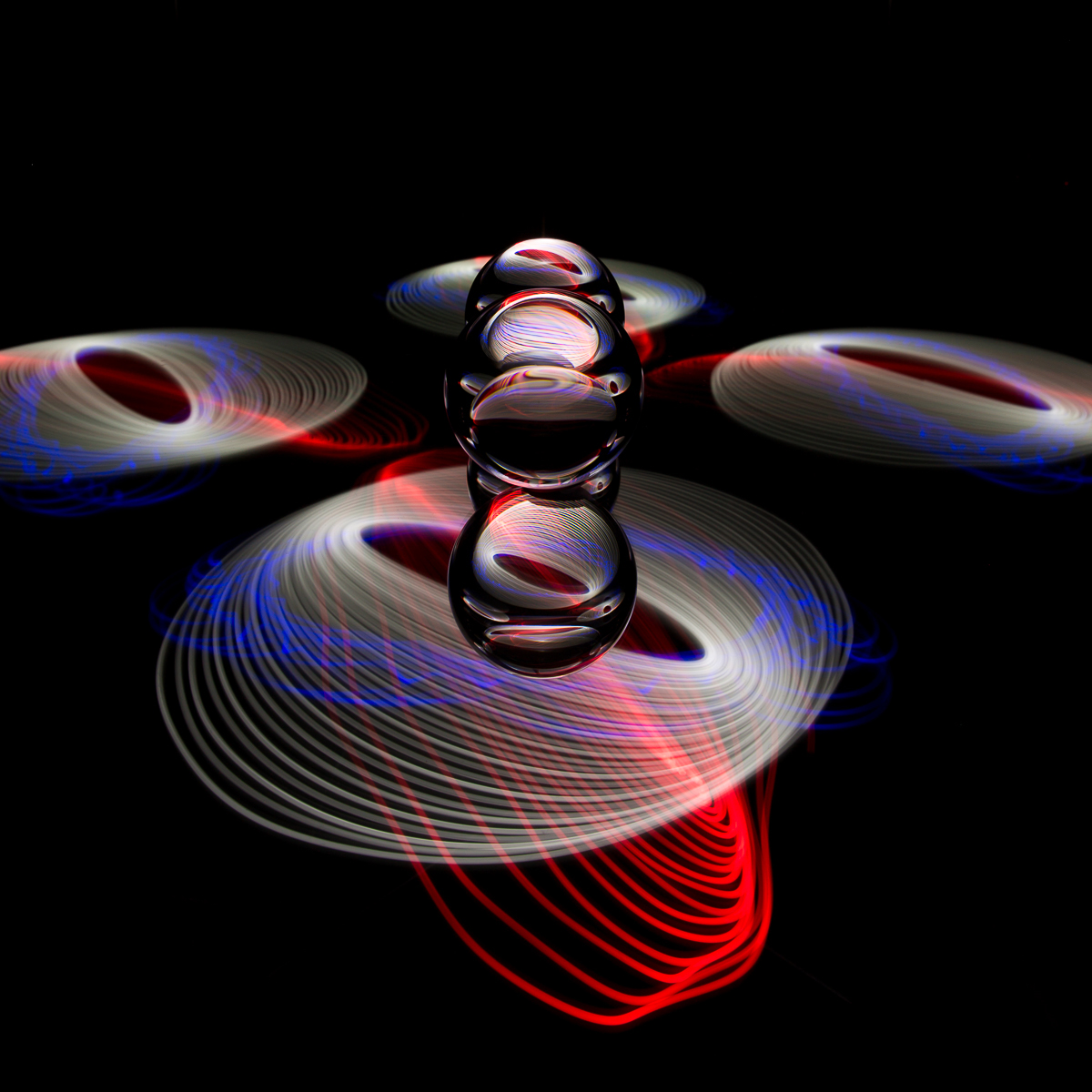
And the winner for the February 2017 Light Painting Photography Contest themed “Spirograph” is… Chris Bauer for his incredible image above titled “GATEWAY TO THE IMAGINATION”. Normally I would say for this awesome winning image Chris will receive a prize pack filled with treasures from our sponsors listed below, but this time its a little bit different. Chris has decided to gift his prize package to the Del Mar High School Photography Program to help spread his passion for Light Painting Photography! 🙂 Thank you Chris I am sure the kids will all slap you high-fives for your awesome gesture!

Here is how Chris created his winning image!

Single exposure light painting made with two lenses.
Gear Used: Nikon D7000 with Nikon 32mm & 200mm lenses.
Settings: f/8, ISO 100, 405 seconds.

First I set up the second half of the exposure using a 200mm lens with a Pringles can attached to it. I set a plasma ball on it’s side and centered it in the middle of the tube then focused the shot. Take a couple practice shots so you already know how much you want to expose the plasma ball later. 12 seconds is what I had decided on. Remove the lens carefully not to disturb the focus and remove the camera but leave the tripod.

Next I prepare the first part of the exposure using a 32mm lens. Set up a physiogram and aim the camera straight up so the light is in the center of the lens. Next I use a sheet of class and position it above the camera and apply water drops . Next focus on the water drops and not the light on the phsyiogram. Now everything is set and in place. Turn out the lights.

With a pink light writer and the flashlight blinking, I spin the phsyio in an oval 
shape until the rotation slows down the cover the lens. Switch to the blue light writer and spin another oval phsyio in the opposite direction and then cover again. Last spin is done with the white light writer in a big circle. When the white light is complete I cover the lens and shut the flashlight off.

Remove the 32mm lens while the camera is still shooting and carefully replace it 
with the 200mm and Pringles can. Attach to the tripod and plug in the plasma, count 12 seconds, then close the shutter.

Check out more from Chris at http://www.thefloweroflight.com

Click here to see the current contest theme and find out how to enter to win your LPP prize pack!

Light-Painting-Brushes-Banner

Click here to see the current contest theme and find out how to enter to win your LPP prize pack!

Filed Under: Light Painting Contest, Light Painting Contest Winner, Light Painting Photography

Light Painting Photography Contest Entries, February 2017

February 22, 2017 by Jason D. Page

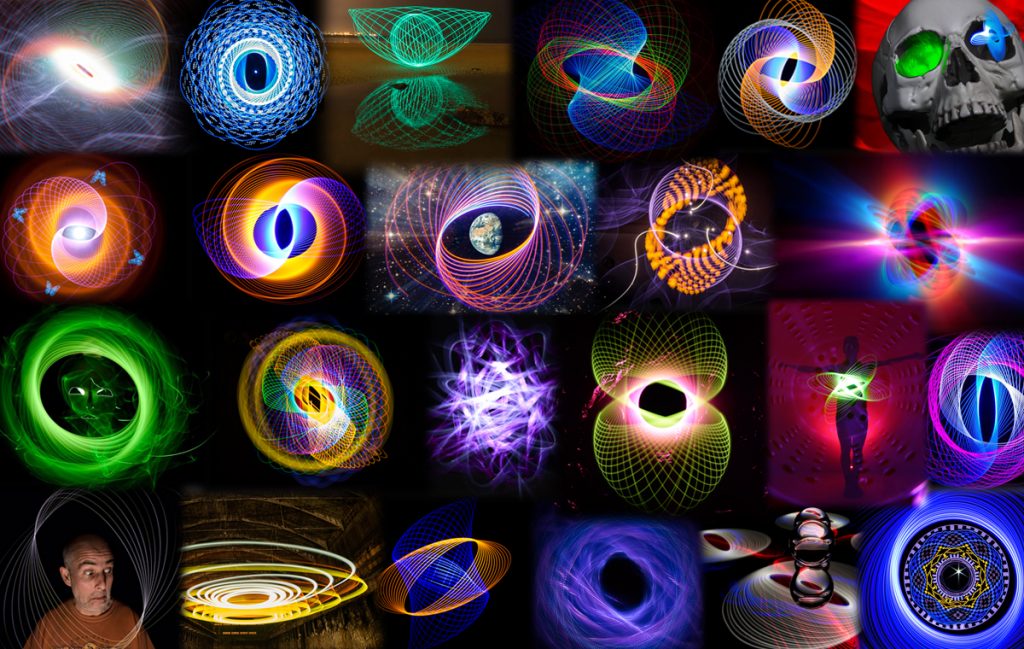
Here are the entries for the February 2017 Light Painting Photography Spirograph Contest! Everyone PLEASE VOTE in the comment section of this page to pick your top 3 images, the images all have a number in the title (EXAMPLE… IF ONE OF YOUR FAVORITES IS THE IMAGE TITLED “Light Painting Contest 08 February 2017″ THEN YOU SHOULD PUT THE NUMBER 8 AS ONE OF YOUR CHOICES). Please remember that the theme of this contest was Spirograph a.k.a. Physiogram! Voters that do not include 3 unique choices in their post will not be counted. In other words no 1,1,1, or 5,5,5, or 7,7,7,…..Please pick your three favorite IMAGES based on the image alone, thank you and enjoy. Voting ENDS February 28th.


The light painting photography contest series is sponsored by the best damn companies on earth COAST Flashlights, Neon Flexible, LED Flexible,and Light Painting Brushes ! Please support these awesome companies that support our light painting art from, without them this contest series would not be possible!
Light-Painting-Brushes-Banner

Filed Under: Light Painting Contest, Light Painting Photography

Light Painting Camera Rotation Rig Ideas!

February 18, 2017 by Jason D. Page


Camera Rotation is a form of Kinetic Light Painting Photography where the lights in the scene generally stay stationary and the camera itself is moved to create the design in the final image. Using Camera Rotation you can take a common scene, ↑like the corner liquor store above ↑, and turn it into something extraordinary. If you are not familiar with Camera Rotation Photography there is a detailed tutorial HERE that will tell you everything you ever wanted to know about the subject!

Camera Rotations are generally created using either a custom made CRT (Camera Rotation Tool) or a bulky Tripod Gimbal. Recently over in the Camera Rotation & Kinetic Photography Facebook group Light Painting Artist Juls Boo shared an idea for an interesting off the shelf solution, the full description of how to build it is pinned to the top of the FB group. His solution basically consist of a couple of L-Brackets and an indexing Rotator that is “normally” used for shooting Panoramics. The best part about using the Indexing Rotator is that the angles are already marked for you eliminating the need for a digital level. Below are a few shots of the set up and examples of images created with the rig, as you can see it breaks down really compact to fit in your bag.

This is what it looks like mounted to a tripod.

Here are some examples of images Juls has created using this rig.


The post Juls made sparked others to share their ideas too. There are a bunch of great ideas and solutions that you should check out but one in particular that seemed super simple was what Dan Chick came up with. Dan’s version is basically one Gemtune DH-55 Panoramic Ball Head with Indexing Rotator, With Quick Release Plate & Clamp and two Fotga Universal Quick Release Plate L Brackets. Why two brackets you might ask, well the answer to that is to help center the weight of the camera over the tripod.  Here are some images of the rig and below is a video that Dan made to show how it all works together!


Here are a few examples of images Dan has created with his rig:


Now go get this stuff and build yourself a rotation rig!

Filed Under: Light Painting Photography

Light Art Digital Magazine

January 30, 2017 by Jason D. Page

Light Painting is GROWING! Just launched last friday is more proof of this with the first ever magazine dedicated to the Light Painting Photography Art Form! Light Art Digital Magazine was created by Sasa Lightpainting and Ramsés Pacheco Light Painter, these guys did a tremendous job on this very first issue! The magazine will be published quarterly and sets out to “be a meeting point, a showcase, a reference and a opportunity of artistic diffusion for light painters around the world”. We are all looking forward to the future of this publication! Please head over to their website where you can download the magazine for FREE in both English and Spanish!

Filed Under: Light Painting Photography

« Previous Page
Next Page »

Copyright © 2026 · News Pro Theme on Genesis Framework · WordPress · Log in