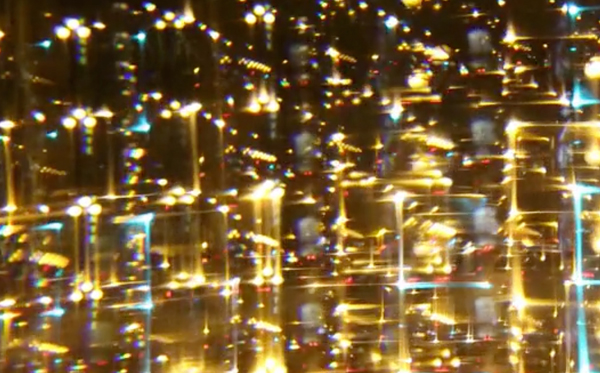
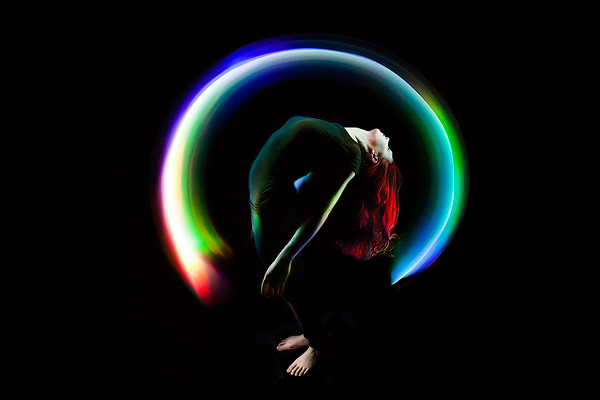
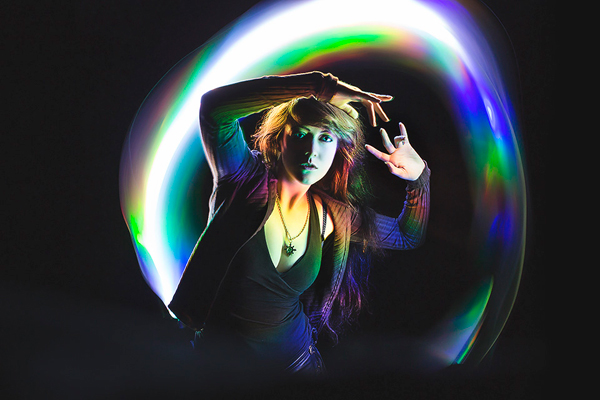
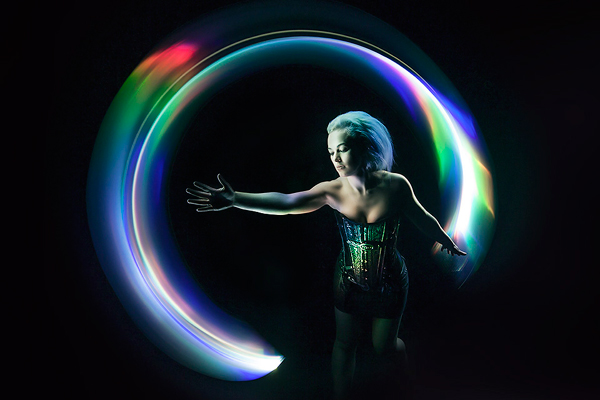
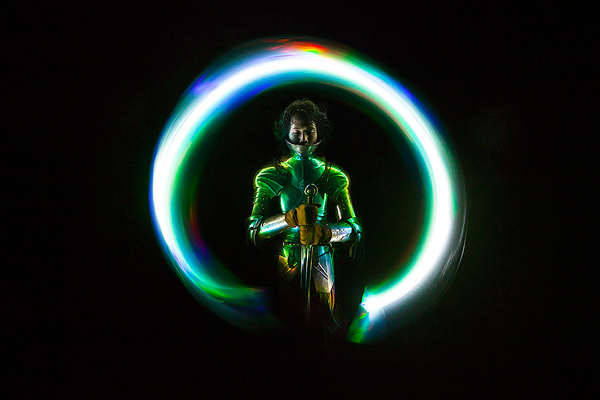
These Fractal Filters look rad for light painting. If your interested in helping make these a reality, and getting all 3 for a good deal check out the Kickstarter page HERE.
SOOC vs SOOC

There has been another spark ignited on the SOOC debate recently, if you don’t know what the SOOC debate is good for you, you may want to stop reading now before you get dragged in…. The SOOC debate is all about should a light painting be “Straight Out Of Camera”, or is some editing of the image OK and if so what does “some” mean… when is it not a light painting anymore? My personal opinion is any photograph is always best to get it right when you shoot it, that is what I personally strive for in my light paintings, but really you can do whatever the hell you want! I just don’t think you should say you created an image entirely in the camera if you added a bunch of layers to it in photoshop or some other digital editing program. I know some LP’s label their shots No Photoshop but tweak them to death in Lightroom, so does that deserve a no PS label?
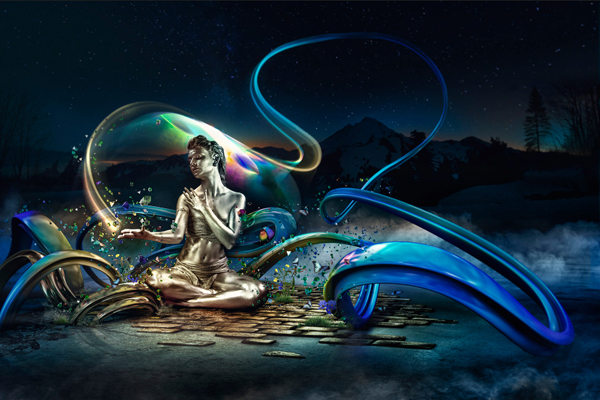
On the other end of the spectrum, Light Painting Photographer Eric Paré Teamed up with digital artist Mike Campau to create a f@#*ing awesome new light painting project (image above) that is SOOC, (straight out of computer), see what I did there… There is no way an image like the edited version of this one could have ever been achieved SOOC, unless maybe your TCB and even with his skill set it would still be pretty difficult. Because this image is out of the computer does that make the light painting part of it any less awesome?
The debate about if a light painting should or should not be edited will rage for at least a little while longer, but as light painting grows and new projects like this one come out opinions will change, or not. Check out the before and after, the BTS video below that shows how much work went into creating the final image, and feel free to post your thoughts in the comments section so we can all look back and laugh 5 years from now…
TCB on CBS
Light Painting Photographer Dana Maltby a.k.a. TCB got some nice exposure on CBS Minnesota this week, check it out below.
P.S. I would just like to say, in my humble opinion, there is nothing “easy” about creating the incredibly complex and masterful works of art that Dana consistently produces or accessing some of his locations in the depths of the city, just saying…
Eric Paré Solar Wind Light Painting Give Away!
Light Painting Photographer Eric Paré, creator of the incredible light painting project LightSpin 360º, is giving away 10 of his Solar Wind light painting tools! To win all you have to do is head over to Eric’s website HERE sign up and share the image on your FB page. 10 winners will be selected on March 7th and Eric will release a tutorial on Ten by Fotolia on March 10th to show you how to create this beautiful light painting effect! ok GO!
Light Painting Photographer Brian Hart on Minnesota Original

Light Painter Brian Hart was recently featured on MN Original (Minnesota Original) for his incredible light drawing work. In the video Brian talks about his experience with light drawing, the process itself, and how he began his journey. You also get an in depth, behind the scenes look into Brian’s unique light drawing composition process. For those of use who have been perplexed at how the hell he makes these complex masterpieces this should open your eyes. Check out the images and video below. For more on Mr. Hart check out his LPP Profile here and his website here. Enjoy.
Ian Hobson Light Painting with the Nokia Lumia 1020
Nokia has teamed up with light painting photographer Ian Hobson to show the slow shutter capabilities of their new phone the Nokia Lumia 1020, the results are excellent! Check out the video below. For the full interview and report from Mr. Hobson check out this link HERE and Nokia is also running a #LumiaLowLight competition for the whole of February on Instagram. “The challenge is simple, share your greatest low light photos with the hashtag #LumiaLowLight on Instagram. At the end of the month Nokia will showcase some of the most awe-inspiring here on Nokia Conversations and the grand winner will receive the world’s greatest camera smartphone, the Nokia Lumia 1020, and a photography kit.” You can find out more on that HERE.
Illuminations – A Light Painting Behind the Scenes
The team of Cameron Edser and Michael Richards, known as GooRoo Animations, have created a light painting Time-lapse project unlike anything you have ever seen before. Best known for their stop motion animation work, Cameron and Michael were inspired by Dennis Smith’s light painting work. They set out to create a time-lapse version of a Ball of Light and I would say the results are absolutely amazing! “A Light Painting Behind the Scenes” is the first installment of this incredibly cool and complex project, they plan to shoot two more installments that “will feature a combination of innovative camera techniques such as motion control, stereoscopic 3D, long exposure, HDR, light painting and time lapse.” Check out the video, BTS images, and interview below! To find out more info, or if you would like to help fund the next two installments of this awesome project please check out http://www.illuminationsproject.com
LPP ∇ Great work on your Illuminations project, its light painting created in a way I have never seen before. First off who was involved and can you give me a little background about each of you?
GR ∇ Our names are Cameron Edser and Michael Richards, and we come from South Australia. We have a significant background in animation. Our stop motion company, GooRoo Animation has produced a number of award winning films, including an animated music video to the song “My Neighbourhood has been overrun by Baboons”, which came 2nd in Tropfest 2010. We also worked on the TV series Danger 5, creating stop motion dinosaurs.
You can see all of our work at www.goorooanimation.com
LPP ∇ I know that you guys do a lot of animation work so what brought you to light painting?
GR ∇ We’ve always had a keen interest in time lapse photography. There are many similarities between stop motion and time lapse. Many of the motion controlled camera rigs we built for animation can be used for time lapse as well. We liked the idea of trying to incorporate light painting into motion time lapse. We were inspired by images of light orbs, and in particular the work of another South Australian, Denis Smith. His “Ball of Light” images are very popular, especially in our home town of Adelaide. We thought it would be pretty cool if we could build a motorised device that could create a light painted orb, and replicate it precisely, frame after frame, so we could capture it in a motion time lapse shot.
LPP ∇ What is the illuminations project all about? The video you released is a behind the scenes making of video, is there going to be another video released that will be different?
GR ∇ The Illuminations Project is a 3 part video series we are looking to fund and produce. It will feature a combination of innovative camera techniques such as motion control, stereoscopic 3D, long exposure, HDR, light painting and time lapse. We want to create impressive imagery with these forms of photography that will take viewers on a journey using visual storytelling.
As part of this project, we’re also excited to be discussing the possibility of mentorship and collaboration with Denis Smith. With his guidance, our photographic and light painting results will hopefully become even more impressive.
The Illuminations behind the scenes film was made with the help of some funding from SA Country Arts. We found it difficult to give an understanding in words what the Illuminations project is all about, so we created this film to convey what we are doing and how we create our image. We also wanted it to act as a showreel so that we can use it to attract the interest of potential investors. We have a website, where you can donate to the project if you are feeling particularly generous and like our work. www.illuminationsproject.com
LPP ∇ How long did the project take?
GR ∇ Most of the nice polished shots in the film have been taken sometime over the last year, but the majority of the filming for all the behind the scenes action was shot over a couple of days recently at Second Valley, South Australia. So you could say the film took a year or two if you include the time we spent building camera rigs, but really this film all came together in a bit over a week.
LPP ∇ How many different locations?
GR ∇ In the film you see Second Valley, SA, various locations in North Queensland, a few shots near mount Arapiles, Victoria, and a few shots in our backyard in the Adelaide Hills, SA.
LPP ∇ Where did the concept come from?
GR ∇ The concept for the film was to be half showreel, half behind the scenes, and thought it would be best to mix the two together in this case. We wanted the film to demonstrate the potential this kind of imagery has on screen, and what to expect from the Illuminations project. The concept of our work is usually developed from experimenting with different camera techniques or other special effects. Our brains seem to be wired for technically orientated problem solving. If we see a cool technique, we want to try it ourselves.
LPP ∇ Can you tell me about the equipment that you used?
GR ∇ We have a Canon 5D Mark II with a range of lenses. Our favourite lens for long exposure time lapses is a 20mm F1.8 prime lens, which is great for shooting the stars.
Our stereoscopic 3D rig is made up of 2 Canon 550D’s mounted side by side, at an adjustable distance apart to get the appropriate 3D effect. Ideally we will acquire a second 5D for future stereoscopic purposes.
The camera rig that you see in the film is a modified Super Track live action camera rig. We have motorised this rig using a belt and pulley system that is driven by stepper motors. It is controlled by an external control unit, where you can set the desired increment the camera moves between frames. The camera and controllers are all synced and triggered via external intervalometers.
We have custom wired all of our cameras, controllers and lights to run off 12 volt lithium batteries to make it through 12-24hours of constant operation without needing mains power. Some of our batteries recharge off portable solar panels.
Out in the field, we have a million pieces of electronics that need to work together in perfect harmony to achieve a result. About 80-90% of the time something goes wrong. It only takes a single inconsistent frame for the entire shot and whole nights work to be ruined. It can be frustrating, but makes it even more rewarding when you get a good result. We’re always working to iron out all the creases in our setup, and it’s getting better all the time.
LPP ∇ Can you talk specifically about the robotic orb making device, how does one create something like that?
GR ∇ We created this device through a process of trial and error. Initially it started out as a pedestal fan, but soon we realised what was required to make it work, and it evolved into the contraption you see in the video. Regular DC motors were used in the early stages but their speed wasn’t 100% consistent, so we were forced to use stepper motors due to their precise degree of accuracy and control.
There is a motor at the top that turns the propeller quickly and a motor at the bottom that turns the whole unit slowly, but the specifics of their movement is quite complicated. At one point, our device became ridiculously complicated. We synchronised the two motors by using a laser beam as a trigger to initiate an exact start point for the light painting to begin for each photo. We’ve now found a slightly more simple way to synchornise them, because the lasers were a bit temperamental.
Throughout the whole building phase we never knew whether or not this device was going to work successfully but with a lot of persistence, we eventually got a result that we were happy with.
LPP ∇ Im sure you will inspire a lot of people to try and build their own mechanical orb makers… What was involved in the post production?
GR ∇ We copy our hundreds or thousands of images off the memory cards, and then place them all on a video editing timeline for just 1 frame each. 25 images make 1 second of footage. They’re sometimes slowed down to half or quarter speeds depending on the subject matter. Occasionally we have to fix the odd inconsistent frame here or there, if for example, a person on a jetty shines a flashlight in the shot for a couple of seconds or a car headlight happens to pass over the frame. There is a lot of this type of thing, because it’s very difficult to find remote locations that are also easy enough to access with all of our gear.
All of our post processes are done twice. Firstly for the left image and then for the right, so that it can later be viewed in stereoscopic 3D. Ideally we try to keep our post work to a minimum, because we prefer to see “in camera” techniques. The star trails are an exception. We use a simple freeware program called “Startrails” to piece the images together in a way that creates the stunning effect of stars streaking across the sky.
LPP ∇ That is a lot of work… What was the most difficult part of the actual film making process?
GR ∇ Technically it is a very challenging project. We build or modify a lot of our gear ourselves because of our specific requirements. Another challenge is to have all of our camera and motion control equipment be portable enough to be packed into the back of a van, where it is transported to remote locations. Then in these remote locations, we have no accessible mains power but we still need the gear to function every day for weeks at a time.
LPP ∇ Anything strange happen while you were out filming, any weird stories you would like to share?
GR ∇ As you can imagine, our setup attracts quite a bit of attention, so we have encountered a variety of curious people on our travels.
Some of the craziest included a guy who thought it would be funny to scare us by firing up a chainsaw and cackling manically, some people illegally hunting right near us with a shotgun, and a guy who tried to break into the van while Cam was sleeping in it. We got out of those places pretty quickly!
Some of the most interesting people have been fellow light painters, photographers, and a tourist who had just been in Mozambique working with the crew shooting David Attenborough’s ‘Africa’ series. We exchanged phone numbers and he ended up staying at Mike’s house while he visited Adelaide.
There is never a shortage of interesting people to meet in remote locations around Australia!
LPP ∇ Holy Hell, a psycho with a chainsaw in the darkness, I would have had a heart attack! It really is incredible work gentlemen thank you for taking the time to answer some questions and I am sure I speak for everyone when I say we can can’t wait to see the next two installments!
GR ∇ Thank you!
RWE Scholarship Opportunity for Light Painters!
The Artist in Residence Program of the RWE Foundation, a charitable foundation of the German energy supplier RWE has a EXCELLENT opportunity for light painting artist!
RWE is looking to pay you and fund your light painting project for up to 6 months! Yes you will get paid €1,000 a month and have all of your expenses paid including lodging, travel, and expenses! This scholarship opportunity is open to everyone including US citizens however the project itself must take place in a European country where RWE is represented. “The VISIT programme of the RWE Foundation promotes young artists by offering them a free space for pursuing individual design work. At the invitation of the Foundation, the selected artists develop their respective project over a period of about three months. Depending on the topic, this takes place at a German or also possibly an international location of the company. The artistic work should have an explicit reference to RWE, the topic of energy, and its social relevance.” Preference is given to the use of electronic media, i.e. the fields of photography…
Heres what you will receive if you are selected:
Duration of assistance: six months
Amount of grant: €1,000 per month (plus incurred travel costs, accommodations, and material costs according to individual agreement)
Payment of the production costs
Final exhibition in the RWE Corporation premises and possibly at external cooperation partners
Project documentation / exhibition catalogue
Energy and light go hand in hand and I know that RWE has a special place in their hearts for light painters (hint, hint)… So get you applications in and get paid to do what you love.
APPLY HERE.
JanLeonardo and Lenovo Light Painting Ad Campaign

As our art form grows it exciting to witness more and more people seeing the commercial appeal of light painting. Recently I shared Darren Pearson’s light painting animation that is currently being featured in Honda’s new ad campaign, now I have the pleasure to share with you another fantastic Ad campaign featuring the work of LAPP founder and all around light painting master JanLeonardo. JanLeonardo’s work is being featured in a global advertising campaign by electronic manufacturer Lenovo! JanLeonardo’s futuristic LightArt-Photography with the sleek design of Lenovo electronics is the perfect fit. Check out some of the images and the short interview with JanLeonardo below ↓↓↓↓↓.
LPP ∇ JanLeonardo the images for the new Lenovo ad campaign look incredible, how did this project happen?
JL ∇ In July 2013 I published an article about my LightArt-Photography in the largest Chinese Photography Magazine “Popular Photography”. The management from Lenovo saw this article and representative from an American advertising agency reached out and contacted me.
LPP ∇ Did you create any special images just for them or did Lenovo select from images that you had already created?
JL ∇ Lenovo acquired publication rights to existing images, but in the future we extend the cooperation.
LPP ∇ Where did you see the first AD with your light painting in it?
JL ∇ I saw videos from the CES and in the background I saw my pictures on the wall. This was an amazing moment for me. I worked since 2007 very hard for this success.
LPP ∇ How long was it before the first contact that you saw your light paintings being used in ads?
JL ∇ We negotiated three month before I saw the Advertising results on the CES. The CES Las Vegas is the biggest international electronics exhibition.
LPP ∇ Where are the images being used?
JL ∇ It’s an international, world wide advertising campaign in internet, print, exhibitions, and wall advertisements.
LPP ∇ That is incredibly exciting! Congratulations your light painting work is mind blowing and I can’t wait to see whats next!
JL ∇ Thank you.
To see more of JanLeonardo’s incredible light painting work check out his LPP profile here and his website www.lightart-photography.de
January Light Painting Contest Entries
Here are the entries for the January light painting photography contest. Everyone PLEASE VOTE in the comments section of this page to pick your top 3 images, the images all have a number in the title (EXAMPLE… IF ONE OF YOUR FAVORITES IS THE IMAGE TITLED “January Light Painting Contest 07″ THEN YOU SHOULD PUT THE NUMBER 7 AS ONE OF YOUR CHOICES). Please remember that the theme of this contest was Interior Landscape Without People, meaning a light painted inside scene.
Voters that do not include 3 unique choices in their post will not be counted. In other words no 1,1,1, or 5,5,5, or 9,9,9…..Please pick your three favorite IMAGES based on the image alone. Vote away!
The light painting photography contest series is sponsored by the best damn companies on earth COAST Flashlights, Neon Flexible, and LED Flexible! Please support these awesome companies that support our light painting art from, without them this contest series would not be possible!