Light Painting Photography

For the promotion and progression of Light Painting Art and Artist.

  • Home
  • Blog
  • History
  • Artists
    • Dean Chamberlain
    • Eric Staller
    • Susan Sims-Hillbrand
    • Vicki DaSilva
    • David Lebe
    • Troy Paiva
    • Bruno Mesrine
    • Chanette Manso
    • Patrick Rochon
    • Aurora Crowley
    • LAPP-PRO
    • JanLeonardo
    • Lightmark
    • Arturo Aguiar
    • Pete Eckert
    • Trevor Williams
    • Michael Bosanko
    • Jason D. Page
    • Nocturne
    • Brian Hart
    • Jeremy Jackson
    • Janne Parviainen
    • Jadikan-LP
    • Dana Maltby
    • Lichtfaktor
    • Dennis Calvert
    • TigTab
    • Hannu Huhtamo
  • Tools
    • Light Painting Brushes Starter Kits Introduction
    • Fiber Optics Light Painting Tools for Photography
  • Tutorials
    • Beginner Light Painting Tutorials
    • Light Painting Tutorials by Artists
    • Light Painting Tool Tutorials
    • Kinetic Light Painting Tutorials
    • Light Painting with Fire Tutorials
    • How To Light Paint A Flower
    • Light Painting Photography Tutorial: The Spiked Orb
    • How To Light Paint a Faberge Orb!
    • No More Orb Feet – Light Erases Darkness
    • The Tinfoil Light Painting Technique
    • How To Light Paint A Ghost
    • Electric Orb Light Painting Tutorial
    • Spirographs and Physiograms Tutorial
    • On Camera Light Source
    • Off Camera Light Source
    • Orb Techniques
    • Steel Wool Tutorial
    • Custom White Balance
    • Omnidirectional Light Cap
    • Gel Holder
    • Simple Orb Tool
    • 4 Ways to Add Color to your Plexiglass Light Painting Brushes
    • Driving Shots at Night
    • Wire Wool Spinning
    • El Wire Tutorial
    • Light Stencils
    • Orbs
    • Dome Tutorial
    • Battery Operated Cathode
    • Light Wheel
    • Double Wheel
    • Fire Wall Tutorial
    • Fire Rain Tutorial
    • Smoke
    • How To Light Paint with the Polaroid One Step +
    • How To Focus In The Dark
    • Light Painting Tutorial The Peacock Technique
    • How To Shoot Defocused Fireworks Tutorial
    • Drone Light Painting Tutorial
    • Light Stencil By Trevor Williams
    • Andrew Whyte Dome Tutorial
    • Light Painting Workshop by Patrick Rochon
    • Rob Turney Refractographs
    • SpiroJib by Johnny Griffin
    • Lens Swap Light Painting Tutorial
    • Camera Rotation Light Painting Tutorial
  • Videos
    • Light Painting Documentaries
      • Jason D. Page Documentary
      • Ball of Light
      • Night Photography: Finding Your Way In The Dark
      • Lightpainted Reality
      • SeeMe | In Focus : Pete Eckert
      • Pete Eckert – Dancing on The Edge of Perception
    • Dean Chamberlain
    • Vicki DaSilva
    • Patrick Rochon
    • Lichtfaktor Light Painting Videos
  • Terms
  • Links
  • Connect With Us!
  • About
You are here: Home / Search for "Digital"

Search Results for: Digital

Janne Parviainen

Serotonia by Janne Parianinen

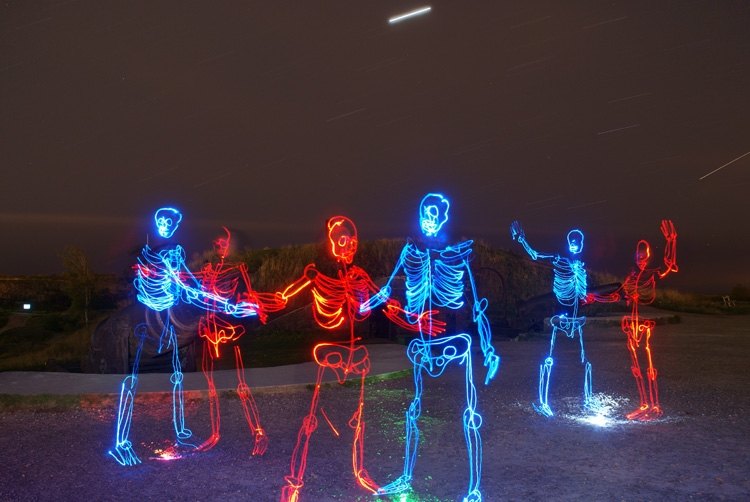
Light Painter Janne Parviainen, also known as JANNEPAINT, is a full time artist who has been snapping photographs for over fifteen years. Like many light painters his discovery of the medium was an accident. In early 2007, Janne was out at night capturing long exposure photographs and accidentally bumped his camera, when he looked at his photograph the street lights had left streaks that appeared to be writing in the image; from that point on Janne was a Light Painter. Janne is well known for his light painting figures and recently he has been producing some amazing skeleton imagery. His favorite things about light painting are the urban exploration and the constant source of inspiration that it provides him. Janne is not only a talented light painter he is also an accomplished oil painter. He creates color painting on glass that are incredible! Read Janne’s full artist interview below and check out his website www.jannepaint.com.

Army of Darkness by Light Painting Artist Janne Parianinen
All We Have Is Now by Light Painting Artist Janne Parianinen
The Future Is Now by Light Painting Artist Janne Parianinen
The Unforgiven by Light Painting Artist Janne Parianinen
Evaporated Masses by Light Painting Artist Janne Parianinen

Only With You I'M Safe by Light Painting Artist Janne Parianinen
Lullalby by Light Painting Artist Janne Parianinen
Post Mortal Anarchy by Light Painting Artist Janne Parianinen
Return to Forever by Light Painting Artist Janne Parianinen
They Only Come Out at Night by Light Painting Artist Janne Parianinen

Painkiller by Light Painting Artist Janne Parianinen
Witchman by Light Painting Artist Janne Parianinen
Wish Upon a Shooting Star by Light Painting Artist Janne Parianinen
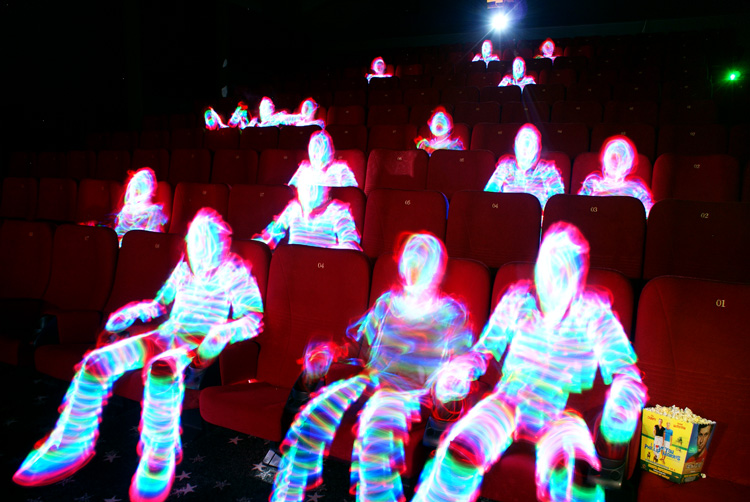
Late Night Show by Light Painting Artist Janne Parianinen
Under a Vail of Stars by Light Painting Artist Janne Parianinen

Human Meadow by Light Painting Artist Janne Parianinen
Serotonia by Janne Parianinen
Savoir Faire by Light Painting Artist Janne Parianinen
Midnight Souls Still Remain by Light Painting Artist Janne Parianinen

Light Painting Photography interview conducted by Jason D. Page in 2011

1. What is your name? Janne Parviainen

2. Do you have an alias that you go by? Jannepaint

3. Are you a soloist or are you part of a Light Painting group? If a group who is in
your group? I’m a solo artist,but I do a lot of collaboration projects too, most often
with my wife Jenni Granqvist alias Missmoody and also with Finnish grafiti artists.

4. What education do you have? I have graduated from art school in 2003

5. What is your occupation? I am a fulltime artist, also I teach oil color painting few
times a week.

6. How long have you been a photographer? I have been photographing for some 15 years.

7. How long have you been light painting? Light painting I have been doing now about
three years.

8. How did you discover Light Painting Photography? I discovered light painting photography
through accident; I had forgotten long exposure mode on from my camera and noticed I can write
with streetlights by moving the camera while it was exposing. Later I posted the photos to
flickr and found the Light Junkies flickr group which inspired me to explore the medium further.

9. What was your first Light Painting Image? My first proper light painting image was a photo
called ‘Cyber Dream’, which was made using children’s toy finger led lights. I must say I’m
still quite satisfied with that photo!

10. Film or Digital? In light painting I prefer digital camera since it eases things a lot.

11. Do you believe in aliens? I believe there might be some sort of living creatures somewhere
in the universe, but I don’t think they would look like our scifi movie image of aliens at all.

12. What is your standard Light Painting Photography setup? The subjects in my light painting
photos tend to be quite often some sort of figures, for example lightmen or light skeletons
combined with urban exploration style backgrounds or Finnish nature landscapes.

13. What is your favorite color? I don’t think I have one single favorite color, it varies so
much depending on circumstances. I could say my favorite *painting* color is yellow ochre.

14. Who influences your Light Painting Photography work? I find seeing other people’s light painting
photos very inspiring, especially Light Junkies group in flickr always pushes the boundaries of light
painting further. When I started light painting I was very impressed of tdub303, tcb and LAPP-Pro’s
photos.

15. Who is your favorite Light Painting Artist? I think tcb is my alltime favorite light painting
photographer.

16. What is your favorite food? I love food, but when it comes to my favorite food, lasagne and sushi
really are the top notch.

17. Do you create in any other mediums other than light painting? If so what are they? My main
profession is ainter, I do oil color paintings on glass, with subjects such as urban street
culture and graffiti as well as traditional nature landscapes. I also enjoy sculpting and video
editing a lot.

18. What is your favorite Light Painting Photography image that you have created? I think my
favorite light painting image is ‘Late Night Show’; an image I made with missmoody. It has a movie
theatre full of lightmen watching a movie. It was really challenging and fun to do, it has 15
lightmen and it took 20 minutes of exposure!

19. What is your favorite Light Painting Photography image of another artist? I have around two
thousand favorite photos in my flickr profile of which most are light painting photos so I don’t
think I can say which would be the number one for me, they’re all too damn good!

20. What is the most difficult part of Light Painting Photography? The trickiest part of light
painting is the fact you have to visualize everything you do into an three dimensional space.

21. How do you get you Light Painting Photography work seen? Flickr is the number one place for
me to get my photos seen, l have around 700-28 000 visitors a day in my photostream.

22. Do you sell your Light Painting Photography work? Selling photos is always rather tricky,
although magazine’s tend to pay fairly well of photos.

23. Are you represented by a gallery? I don’t have any specific gallery to represent me.

24. Where can we see more of your work? More of my work can be seen on my netsite jannepaint.com

25. What is your favorite quote? I don’t think I have any specific quote; well,
‘all people are equal’ is a good place to start!

26. Who is your favorite artist? My favorite artist must be Gustav Klimt, his paintings
are incredible!

27. What is you favorite activity other than light painting? I really enjoy reading,
listening to music and eating.

28. Tell me a good light painting story….I went out light paintig at about 3 am in July
and all the birds were singing and it was so quiet otherwise, the air was full of the most
amazing and pleasant scents and I really felt I was having the best time of my life! I just
stood there in the middle of the field and thought how everything can be so beautiful.
And even my photos turned out to be great! I wish life could be like that always!

29. Tell me a nightmare light painting story…I was light painting with my wife in an abandoned
mental hospital and we were in the dark, really scary looking cellar of the building when we heard
that someone came into the building from a nearby door. We tried to be veeery quiet and not get
noticed but about half a minute later there was this huge, bearded man on the doorway shouting to us!
Luckily it turned out he wasn’t a psycho wanting to kill us, but a janitor of the building. He had
seen us going into the building from his house across the street and went after us to see if we
were going to vandalize the building. It all went well in the end, he allowed us to continue
photographing after we had explained the situation, but still it freaked the hell of us!

30. Have you ever been arrested or ticketed for light painting? One time I was light painting in a
field about 500 meters from my house and I had taken a sword with me for the photo. When I came back
to my house, a police car came around the corner and stopped me to question me what I was doing with
a sword! Luckily they weren’t of an uptight sort, so I got away from the situation after I had shown
them the photos I had taken.

31. What do you say to people when they see you light painting and they ask “what the hell are you doing”?
I think I have heard that question about a million times already, nowadays I usually say I’m doing an
art performance since it’s easier than starting to explain the whole concept of light painting!

32. Where do you find inspiration for your Light Painting Photography? I find light painting a constant source of inspiration, my mind is just buzzing with new ideas all the time! It’s just so much fun to do!

33. Who would you like to punch? If there would be a person whom to blame of the current state of capitalism and globalisation, I would punch him!

34. Who would you like to kiss? I kiss my wife plenty, so my wish has already came true!

35. Why do you Light Paint? Light painting is the most liberating form of art I have encountered; it sums up so many good things in one package that I could never let go of it anymore!

36. What is your favorite time to shoot? My favorite time to light paint varies a lot; on the summer time it is so bright in Finland that the only time it is possible is from around 2 am to 5 am, but those hours really are magical! In the winter time I usually am light painting from around 6pm to 11pm.

37. What is your favorite subject to shoot?? I really enjoy shooting in abandoned places, urban exploration is very addicting!

38. Where is your favorite place to shoot? My favorite place to shoot is an abandoned mansion forest in the outskirts of Helsinki called Kruunuvuori. It is a really creepy looking old forest with 7 huge abandoned and halfly collapsed mansions that look like straight out of a horror movie! It’s a magical and an inspiring place!

39. If you could travel anywhere to Light Paint where would you go? My dream light painting place would be Egypt. I’d love to do a light painting in ancient ruins of Karnak or the pyramids.

40. Have you ever invented a Light Painting Photography tool? If so what was it and how did it work? I usually use only normal flashlights or led lights so I don’t think I can take credit of inventing anything terribly fancy…

41. Do you ever get sick of explaining your work to people? I think I can sum up the technique into quite short after all these years I have had to explain it, haha!

42. How many times have you heard the work photoshop when someone was describing or asking about your work?? I think Photoshop is a curse word among the light painters; it’s that often…

43. What makes you happy? I’m very happy when I take a great photo or after I finish a painting, those things are like a drug to me. Making people happy never ceases to do the same for you too!

44. What makes you mad? Seeing where the world is heading makes me mad.

45. What part of Light Painting Photography do you enjoy the most?? I love the ticklish feeling in my tummy just before getting into a new cool place to shoot.

46. What part of Light Painting Photography do you hate the most? I hate the feeling when you have to come back from a shooting trip with nothing proper to show of it, it is devastating.

47. Do you have a website? If yes what is the address? www.jannepaint.com

48. What is Light Painting Photography? Light painting and light drawing are ways of photography where photo is manipulated with different kind of light sources while the camera is exposing on a long exposure time in a dark or lowly lit place. The idea of the light painting is that all photos should be straight from the camera, without any post editing such as Photoshop, etc.

49. Give me some advice for anyone that might like to try Light Painting Photography…The exposure times used in light painting vary from few seconds to hours, depending on the desired effect. Often used tools for light painting are flashlights, colored flashes, led sticks, el wire (battery operated led wire), battery operated Christmas lights, childrens’ light toys such as light swords etc, or tools specially built for light painting. Colored flashes and flashlights are easy to make by placing different kind of colored gels on them. Colored flashes and flashlights are great for lighting up the scenery when taking photos in the dark, or just highlighting certain areas in the photo. By moving led sticks, flashlights and other light sources in the photos’ area while the camera is exposing it is possible to create different kind of shapes and effects.

When light painting it is recommended to use a tripod, or to place the camera on a steady ground since in long exposure times undesired trembling of the camera can easily ruin the photo. Even though camera’s light sensitivity raises when using higher ISO-characters, a small ISO-number guarantees a better photo quality when taking photos in the dark. Camera’s aperture figure is good to set according to the scenery’s overall lighting and to the brightness of the light tool used; In a low lit space and when using dimmer lights a small aperture figure works best, where as in a brighter space and when using powerful lights a bigger aperture figure is needed. When choosing for the correct aperture figure it is good to remember that even a very low lit scenery will turn out to be quite bright in the final picture when using long exposure times. A Bulb switch is a good purchase when wanting longer exposure times than the usual 30 seconds in the most DSLR cameras. In the dark it’s of great help to use a bright flashlight when focusing, also you can use camera’s autofocus with the flash and then locking the focus or turn the focus on manual witch has the same effect.

50. Are you scared of the dark? I used to be very afraid of the dark when I was a kid, but not now anymore which is a good thing light painting wise, haha!

Eric Staller

Eric Staller – Light Drawing Pioneer


Light Painting by Eric Staller

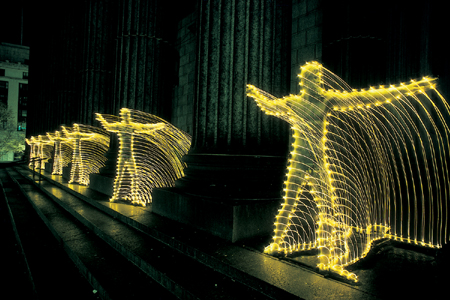
Light artist Eric Staller could be called the father of light drawing or light graffiti in its present-day form. Born in 1947 in New York, Eric studied architecture at the University of Michigan and graduated with a bachelor’s degree in 1971. Towards the end of his time at UOM, he began creating sculpture and performance art. From 1976 to 1980, Eric roamed the dark streets of New York City, capturing light painting photographs. His Light Drawing series may be considered the first Light Art Performance Photographs ever created.

While some argue Man Ray’s “Space Writing” series came first, Staller’s iconic works like Light Tubes, Happy Street, and Technicolor Torsos introduced performance art within photography on a new level. He set up his camera, opened the shutter, and moved through the frame using handheld light sources. His series remains one of the most influential on contemporary light painters today.

Visit his website: www.ericstaller.com

Light Painting by Eric Staller Poseidon
Light Painting Eric Staller's Happy Street
Light Painting Eric Staller's Technicolor Torsos
Light Painting Eric Staller's "Dear Mom And Dad"
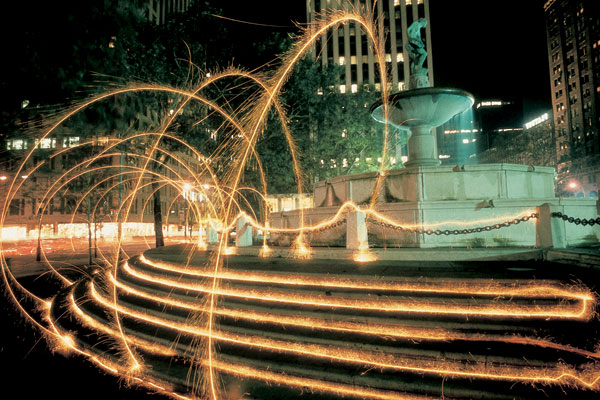
Light Painting Eric Staller's Pulitzer Fountain

Light Painting Eric Staller's Window Dressing
Light Painting Eric Staller's Ribbon on Hannover Street
Light Painting Eric Staller's Light Tubes
Eric Staller's Light Tunnel


Eric Staller Interview with Jason D. Page

Light Painting by Eric Staller Domes

Interview conducted by Jason D. Page in 2012

LPP ∇ It is wonderful to get the chance to pick your brain a bit to see what you were thinking when you created some of your first light drawing images that have inspired a countless number of light painting photographers!

ES ∇ ‘Walker Street’ was the first image that I printed. It was a 1-minute ‘sparkler drawing’ I did in front of my loft in lower Manhattan. Each sparkler lasted about a minute, so that was the amount of time I had to make the drawing. I would lock the camera shutter open, light the sparkler and quickly walk down the street, holding the sparkler at curb level, to complete the composition before the sparkler went out. I felt a strong sense of exhilaration, like running the 100-meter dash with a flaming torch! Getting the film back from the lab was even more exhilarating: it was magic, my presence was invisible! There was just this trail of liquid fire. Suddenly I was drunk with the possibilities. I proceeded to outline everything for my photos: cars, trucks, streets, and monuments.


Light Painting by Eric Staller

LPP ∇ What inspired you to create some of your first light drawings?

ES ∇ I had been doing slide shows, timer –activated installations of slide projections onto gallery walls, or screens suspending in space. They were moving paintings, musically inspired and consisted of a few hundred images that were seen dissolving into one another on the screen. This was many years before computerized multi-media and I remember how disturbing it was when my NY gallery called me to say that one of my slide projectors had jammed! I resolved to compact my choreography into still images, that I printed 30” x 40”. These have since been exhibited worldwide, although at the time most people didn’t know what to make of them.

LPP ∇ Funny you say that, presently when a light painter shows their work people usually think that the image is has been digitally altered. You had exhibited your light painting work worldwide but people at the time didn’t know what to think of it, can you expand on that a little bit. What were some of the reactions then and how do people react differently to it now?

ES ∇ I was represented by an art gallery in NY and when I did this series I thought I would be better represented by a photography gallery. Directors of photo galleries didn’t think what I was doing was photography!! It was thought to be a gimmick, a trick. Now (smart) people know I was ahead of my time!

LPP ∇ Was there a moment when it all clicked or was this series more of a work of trial and error?

ES ∇ I have had many ‘inspired accidents’ in my career but mostly I have a scientific approach to taking my work intellectually further with each artwork.

LPP ∇ What is your favorite light drawing you have ever created?

ES ∇ My next artwork is my favorite!

LPP ∇ Did you work alone or was someone there helping you to create some of your images?

ES ∇ I started working alone but hired an assistant once I received my first grant. Having an assistant enabled me to take longer and more elaborate shots.

LPP ∇ I know that you must have had some interesting encounters roaming the dark streets of New York in the middle of the night with sparklers and camera gear, is there anything you would like to share? Any interesting stories that happened on one of your light drawing shoots?

ES ∇ The city at night was an enchanting place for me. The plazas, bridges, parks and monuments, empty and eerily quiet at night, were dramatic stage sets waiting to be transformed.


Light Painting by Eric Staller

Late at night I drove around in a beat-up station wagon, looking for places and ideas to jump out at me. When the moment was right I set up my Nikon on a tripod and planned a choreography with light. At dawn I would go to Fulton Street to watch the fishermen come in, or to the Lower East Side for the first hot bagels of the day.

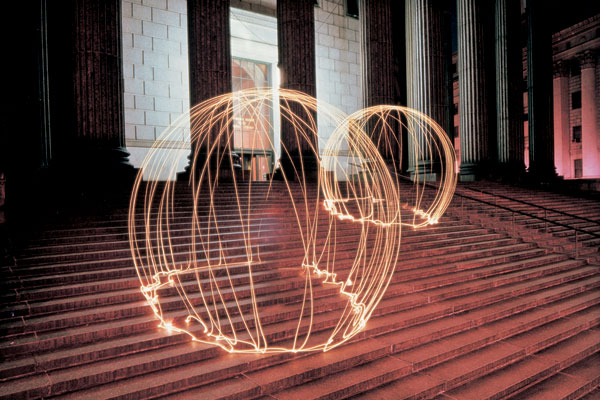
My dreams in 1977 were taking the forms of fantasy architectures of light. I invented choreographies and volumes of light. I remember being impressed by the architectural uses of the human figure in Fritz Lang’s film ‘Metropolis’ and old Busby Berkeley films, and I began to think of the geometry of my body. By then I found that a 10-minute sparkler was available on special order. I attached one to the end of a broomstick and, using my arm as a compass, scribed arcs overhead as I walked up the middle of the street (Lightunnel).


Eric Staller's Light Tunnel

For Lightubes I spun the sparkler on the end of a string as I walked toward the camera; then ran back and did it again.


Eric Staller's Light Tubes

I mounted 5 sparklers on a broomstick and held it vertically, at arm’s length for the 5-minute exposure Ribbon on Hanover Street.


Eric Staller's Ribbon on Hannover Street

It occurred to me more than once that these were performances with light. Crowds of curious garbage men, night watchmen, workaholic Wall Streeters and the homeless gathered to watch the lunatic with the blazing broomstick!

LPP ∇ Prior to creating your own images had you ever seen any of Man Ray’s, Gjon Mili’s, or any other light drawing work, if so what did you think of this work?

ES ∇ I had known of the Picasso/Mili drawings.

LPP ∇ You call your work “Light Drawings” but you also talk about the performances. Are you familiar with the current “Light Art Performance Photography” and if so do you feel some of your early work should fall into this category or something different?

ES ∇ What I was doing was certainly performances with various light sources but it was the image, the end result that I was interested in. I’m not very interested in being categorized.

LPP ∇ You have shifted focus a bit from your light drawing work, do you still create in this medium or were you completed in 1980?

ES ∇ I have shifted more than a bit! I evolved from the photography into computerized light sculpture. My Lightmobile in 1985 was perhaps my most profound personal breakthrough, and the beginning of my ‘urban UFO’ series.


Since then my work has all been performance oriented, and increasingly political. And a lot of my job is manufacturing, promoting and marketing my circular 7-person ConferenceBike. See conferencebike.com

LPP ∇ What do you think of the present state of light painting photography?

ES ∇ It is amazing that it has become this movement, and there is a lot of great energy out there. There are some beautiful images being done, but most of the work has a generic-ness to it. I don’t see that anyone has taken it further than what I did more than 30 years ago.

LPP ∇ Are there any light painting artists that you follow or that ARE impressing you with the work they are producing?

ES ∇ Of all the artists on your site my favorite is LAPP-PRO.

LPP ∇ Do you think light painting has further to go? As one of the light drawing founders what do you think is the next step, or how would you as like to see it evolve?

ES ∇ The art form will certainly continue to evolve, just as more traditional art forms have continued to evolve. As with painting and sculpture, with their long traditions, the real innovations are few and far between. In fact, the easier it is to master a technique, the easier it is to fall into a mannerist sameness that most light painting/drawing falls into. Invention, originality, daring, that’s what I look for in art, and I rarely see it. The artist Christo is one artist that really interests me.

LPP ∇ Do you have any desire to revisit another light drawing series?

ES ∇ I felt that I took it as far as I could and that I was becoming too good at it! The surprise was going out of it and I moved on before I started to repeat myself. I don’t want to ever say never, but I am VERY doubtful that I will go back there.

LPP ∇ Thank you for taking the time to answer some questions. It has been great to talk to you.

ES ∇ You can thank me by ordering my book OUT OF MY MIND! There you will find 30 images beautifully reproduced, of these photos, that I did between 1976-80.

Jeremy Jackson


Light Painter Tackyshack self portrait in his shack.

Light Painting Photographer Jeremy Jackson, also known as TACKYSHACK, has a style all his own. His light painting photographs are fun and bright. Jeremy is well known for creating his “Fire and Light Masks”. He has only been light painting since 2007 but in that time he has put in more work and created more images than light painters that have been shooting twice as long. He has already created more than 150 of his “Fire and Light Masks” along with hundreds of other images. Jeremy’s dedication to light painting photography is inspiring. He shoots on 35mm film as well as digital. Tackyshack explains light painting like this, “The world is your canvas. Anything you can imagine can be painted a million different ways, time and space take on new meaning”. View some of his images and read his full light painting photography  interview below. For even more of his work check out his website TACKYSHACK.NET.

Camera Toss #529 by Light Painting Artist Jeremy Jackson
Camera Toss #560, The EYE 2 by Light Painting Artist Jeremy Jackson
Fire Spiral Tunnel Action by Light Painting Artist Jeremy Jackson
To the Tree and Back V7 by Light Painting Artist Jeremy Jackson
Camera Toss #265 by Light Painting Artist Jeremy Jackson

Camera Toss #295 by Light Painting Artist Jeremy Jackson
Fire and Light Mask #146 by Light Painting Artist Jeremy Jackson
Fire and Light Mask #120 by Light Painting Artist Jeremy Jackson
The Tackymen Circle Presentation by Light Painting Artist Jeremy Jackson
Fire and Light Mask #152 by Light Painting Artist Jeremy Jackson

Fire and Light Mask #101, OWL by Light Painting Artist Jeremy Jackson
Fire and Light Mask #136 by Light Painting Artist Jeremy Jackson
Fire and Light Mask #150 by Light Painting Artist Jeremy Jackson
Painting the Cold Forest by Light Painting Artist Jeremy Jackson
Fiz-Iks Crew Amidst Bubble Land 2 by Light Painting Artist Jeremy Jackson

Bubbles + Gorilla Pad=Good by Light Painting Artist Jeremy Jackson
Fire and Light Mask #21 by Light Painting Artist Jeremy Jackson
Fire and Light Mask #107 by Light Painting Artist Jeremy Jackson
Fire and Light Mask #111 by Light Painting Artist Jeremy Jackson
Light Painter Tackyshack self portrait in his shack.

Light Painting Photography interview conducted by Jason D. Page in 2011

1. What is your name? Jeremy Jackson

2. Do you have an alias that you go by? Tackyshack

3. Are you a soloist or are you part of a Light Painting group? If a group who is in your group? Soloist who likes to collaborate with anyone interested.

4. What education do you have? Master’s Degree in Special Education

5. What is your occupation? Teacher

6. How long have you been a photographer? As long as I have been a light painter (1.5

years)

7. How long have you been light painting? About a year and a half.

8. How did you discover Light Painting Photography? Playing around with glowsticks

and my point and shoot. Discovered light junkies on flickr shortly after and haven’t been

the same since! =)

9. What was your first Light Painting Image? A glowstick “tunnel” in which I connected them in a loop and walked away from the lens to create the tunnel effect. It was done on my point and shoot at a high ISO so it was super noisy.

10. Film or Digital? I shoot both. Digital for convenience, film for saturation, colors and the magic of having a light painting shot on a single frame of film.

11. Do you believe in aliens? Sure. Sometimes I think we are the aliens. We are unlike any other species on this planet.

12. What is your standard Light Painting Photography setup? Steel wool and LED light

tools of various types (LED swords, built tools like my LED wheel or RGB strip, etc.) being used in my yard across a choreographed composition.

13. What is your favorite color? Blue

14. Who influences your Light Painting Photography work? Everyone who waves lights in front of a lens. I could list a ton of light painters here.

15. Who is your favorite Light Painting Artist? Just one? Geez¼. If it’s only one then it would have to be tcb. I’d say most of the light painting community would agree with me.

16. What is your favorite food? Stir Fry

17. Do you create in any other mediums other than light painting? If so what are they? I enjoy painting and drawing patterns. Nothing serious though.
18. What is your favorite Light Painting Photography image that you have created? It

would have to be my Fire & Light Mask “Shaak Ti” (Named by my fellow painter in

Argentina, Santiago.) It was an eye opening and magic moment and still one of my best masks to date despite creating 100 since then.

19. What is your favorite Light Painting Photography image of another artist? Probably

tdub303’s “Best Nest”. There are so many incredible shots from all of the artists out there that this is tough to say.

20. What is the most difficult part of Light Painting Photography? Loss of sleep by far is the most difficult thing to deal with. Everything else is fun in my book.

21. How do you get you Light Painting Photography work seen? Mostly flickr. I have

displayed in a few local galleries and such but the cost of printing and time/energy

invested in gallery displays is a deterrent for me. I need to be thinking more along these

lines and getting more business oriented though. It’s much more fun being an artist!

22. Do you sell your Light Painting Photography work? I’d love to but haven’t sold much as of yet. I need a system for this.

23. Are you represented by a gallery? Nope. Would be cool though.

24. Where can we see more of your work? Right now my website or flickr are the best

options. I have a facebook fanpage as well but think the photos look better on flickr.

25. What is your favorite quote? “Life is what happens in between making plans.”

(Lennon)

26. Who is your favorite artist? Alex Grey

27. What is you favorite activity other than light painting? Hanging out with my wife and kids, family, and friends.

28. Tell me a good light painting story. One of my best friends growing up recently came

into town and we had a 14 hour photographic endeavor. We light painted in 3 different counties from 6 PM to 8 AM. Every stop was a blast and we finished the collaborations off with some extraordinary sunrise shots in the forest next to my house.

29. Tell me a nightmare light painting story. I can’t think of any specific instance. I mean, if I come away from any night with a light painting photo then I’m content no matter how difficult the circumstances may have been.

30. Have you ever been arrested or ticketed for light painting? Not yet¼.

31. What do you say to people when they see you light painting and they ask “what

the hell are you doing”? Making art!
32. Where do you find inspiration for your Light Painting Photography? All of the great

light painters from the light junkies group on flickr.

33. Who would you like to punch? I’m a pacifist.

34. Who would you like to kiss? My wife.

35. Why do you Light Paint? It’s my outlet. My means of escaping traditional time and space. Not to mention it’s an absolute blast and magical every time I open the shutter.

36. What is your favorite time to shoot? Any time I can make time is the right time.

37. What is your favorite subject to shoot? I dunno¼. Nature I suppose.

38. Where is your favorite place to shoot? Out in my yard. I’ve been to a ton of great

locations but I have a level of comfort in my yard and can step into my shack to grab a light tool if it’s needed.

39. If you could travel anywhere to Light Paint where would you go? Oh man¼.

Australia? England? The drains of Minneapolis? Japan? Honestly, anywhere I could

meet an awesome light painter and collaborate some shots with them on their turf.

40. Have you ever invented a Light Painting Photography tool? If so what was it and

how did it work? Sure. I mean, I use other light painters’ ideas and make them my own. In terms of inventing¼ I think there is an awful lot of hullabaloo over who is the “first” or

“originator” and think it distracts from the artwork itself. That being said, I have built many tools but I’m not in this to be an inventor. I’m an artist and advocate.

41. Do you ever get sick of explaining your work to people? Oh yeah. Definitely. I

absolutely love the art form but find myself wanting to hand out a written explanation or point them to videos so I can save my breath.

42. How many times have you heard the work photoshop when someone was

describing or asking about your work? Several. I think the funniest comment is “Great

processing.” I guess they’re complimenting the sensor on my camera. Ha!

43. What makes you happy? Time spent with family and friends.

44. What makes you mad? Feeling overwhelmed with responsibilities and everyday

tasks. That and having to get up early. =)

45. What part of Light Painting Photography do you enjoy the most? The moment you close the shutter and see your creation for the first time.
46. What part of Light Painting Photography do you hate the most? Loss of sleep. I’m a

night owl and enjoy the late nights but the mornings are no fun.

47. Do you have a website? If yes what is the address? Yes. http://www.tackyshack.net

48. What is Light Painting Photography? The world is your canvas and light is your

medium. Anything you can imagine can be painted with light a million different ways. Time and space take on new meaning.

49. Give me some advice for anyone that might like to try Light Painting

Photography. Be patient and don’t give up on great concepts. Learn to use varying apertures on your camera and try moving your light sources at varying speeds. Once

you have a technique down, combine it with other new learned techniques to create

even more intriguing photos. Most importantly, study the light painting that’s already out

there. Find the photos that intrigue you and view the aperture, ISO, and exposure time to understand the best settings for specific circumstances.

50. Are you scared of the dark? Nope. I mean, I’ve been spooked numerous times

while out light painting but ultimately I have learned to embrace the great outdoors at

night. Whether I was taking photos or not, there is something magic about it all.

Jadikan-LP

Guilhem Nicolas – Light Painting Artist Jadikan-LP

Light Painting Portrait by Jadikan

Light Painting Photographer Guilhem Nicolas, also known as Jadikan-LP, has experimented with long exposure photography for many years; in 2008 he discovered Light Painting Photography and has been hooked ever since. “Jadikan” is a Malaysian word that means “to create or transform.” Guilhem wants his work to bring transformation to his viewers and convey that we are all light—and capable of creating Light Art.

Known for his mystery and secretive process, Guilhem works mainly in France and enjoys creating with a wide range of subjects—from the human form to architecture. He recently traveled to Nepal to create a tribute to his favorite street artist, Space Invader. Scroll down to view some of his images, read his full interview, and explore more on his website: jadikan-lp.com.

Light Painting Photography by Jadikan

Light Painting Photography by Jadikan

Light Painting Photography by Jadikan

Light Painting Photography Interview

Interview conducted by Jason D. Page in 2010

1.. What is your name?
Guilhem

2.. Do you have an alias that you go by?
Finally admit that jadikan is an alias 😉

3.. Are you a soloist or are you part of a Light Painting group? If a group who is in your group?
I usually work alone for the photography and the light painting job but I like to share competencies for specific projects.

4.. What education do you have?
Master of international economic policy …

5.. What is your occupation?
I can maybe say « visual artist » and my artwork is based on light painting photography

6.. How long have you been a photographer?
Full time job since 2 years but I use photography for different purposes since I am 14.

7.. How long have you been light painting?
4 to 7 years, depend on what level of addiction you are talking about. The first image I can be proud is from 2007. 25 seconds exposure. At this period, I was more into stencilling and wanted to make a picture of the 2 trumpetists I just sprayed.

8.. How did you discover Light Painting Photography?
Mistakes and repetition to handle them

9.. What was your first Light Painting Image?
Lost in southeast Asia in 2005, a cigarette and a cheap digital compact camera made me understand the concept.

10.. Film or Digital?
My first experiences with photography were film and I went digital when I discovered light painting in 2005. I use film again for some upcoming projects

11.. Do you believe in aliens?
Why not.

12.. What is your standard Light Painting Photography setup?
Camera on tripod with a remote. A location that you feel good with. Few selected light tools. Music sometimes… snacks, water and beers can help too, because light painting expeditions can last long…

13.. What is your favorite color?
I don’t know yet, and I am not sure I will find one

14.. Who influences your Light Painting Photography work?
Light painting has enough possibility to draw your own way.

15.. Who is your favorite Light Painting Artist?
Many light painting artists have their own touch, can be subtle with this art, and I like a lot of them! In my opinion, Dana Maltby aka TCB is one of those who made some really inventive photographs in this discipline the last two years.

16.. What is your favorite food?
Anything I am hungry for …

17.. Do you create in any other mediums other than light painting? If so what are they?
Light painting discipline links you to create light sources, think about choreography, drawing, installations, videos…

18.. What is your favorite Light Painting Photography image that you have created?
Next one will be so new!

19.. What is your favorite Light Painting Photography image of another artist?
I am in admiration of Tokihiro Sato’s “Photo-respiration” series—especially the daylight part. Light painting with an 8×10 large format view camera!

20.. What is the most difficult part of Light Painting Photography?
Be sure of what you want to light paint

21.. How do you get your Light Painting Photography work seen?
Websites, magazines, galleries, festivals or live shows

22.. Do you sell your Light Painting Photography work?
Yes

23.. Are you represented by a gallery?
No

24.. Where can we see more of your work?
Website www.jadikan-lp.com for selected images. Every exhibition has special and unpublished artwork to discover. I like to keep some surprises for those who can join those events. You can also be my “facebook friend” for updated news 😉

25.. What is your favorite quote?
None

26.. Who is your favorite artist?
I cannot say that I have a favorite artist but I try to open my eyes more than necessary to appreciate new stuff

27.. What is your favorite activity other than light painting?
Gardening

28.. Tell me a good light painting story.
So many, but the light painting experiences I made with the Nepalese people in some temples are unforgettable

29.. Tell me a nightmare light painting story.
Arriving at home and remembering that I forgot my last homemade torch on location… and this specific location was quite far and not really easy to enter

30.. Have you ever been arrested or ticketed for light painting?
Never, but I didn’t say that I was not close …

31.. What do you say to people when they see you light painting and they ask “what the hell are you doing”?
Please have a look, it is difficult to explain clearly

32.. Where do you find inspiration for your Light Painting Photography?
On location

33.. Who would you like to punch?
No one

34.. Who would you like to kiss?
It is too late to say thank you to Nicephore Niepce but if I could …

35.. Why do you Light Paint?
This question is on my “to do list”

36.. What is your favorite time to shoot?
When the idea of the final composition starts to blink in my mind

37.. What is your favorite subject to shoot?
Locations with shadow opportunities

38.. Where is your favorite place to shoot?
I feel well in most of the quiet and dark locations I choose

39.. If you could travel anywhere to Light Paint where would you go?
I will go there.

40.. Have you ever invented a Light Painting Photography tool? If so what was it and how did it work?
Most of my tools are customized for a special use… and it is quite simple 😉

41.. Do you ever get sick of explaining your work to people?
Never

42.. How many times have you heard the word Photoshop when someone was describing or asking about your work?
Often but they usually quickly understand

43.. What makes you happy?
Good news

44.. What makes you mad?
Things I don’t understand

45.. What part of Light Painting Photography do you enjoy the most?
Walking in a dark and huge location with a very tiny light torch

46.. What part of Light Painting Photography do you hate the most?
Run out of batteries or a sunset just before finalizing the photograph you want can be a nightmare.

47.. Do you have a website? If yes what is the address?
jadikan-lp.com

48.. What is Light Painting Photography?
Being mad about photography and other possibilities to catch light performances.

49.. Give me some advice for anyone that might like to try Light Painting Photography.
If you manage to do it once, do it again to be sure!

50.. Are you scared of the dark?
Sometimes, it depends where you are…

➡️ Learn the basics: Light Painting 101
📚 Discover more artists: Meet the Artists

Jason D. Page


Light Painting by Jason D. Page

Jason D. Page has been a photographer since 1994 and a light painting artist since 2004. His journey began with his “Moonlight Drawings,” using the light of the moon to create shapes in the night sky. Jason is deeply passionate about sharing and expanding the art form of Light Painting.

He is the founder of LightPaintingPhotography.com and the inventor of the Light Painting Brushes, a universal system of easy-to-use Light Painting Tools. Jason prefers to shoot alone deep in the woods, where solitude and mystery fuel his creativity. He built this platform to uplift the Light Painting community and share what he’s learned from decades of experience.

View some of Jason’s images in the gallery below and scroll down to read his full artist interview. For even more, visit his personal site at jasondpage.com.

Light Painting by Jason D. Page

Light Painting by Jason D. Page

Light Painting by Jason D. Page

Light Painting Print by Jason D. Page
Light Painting by Jason D. Page

Light Painting Photography Interview with Jason D. Page

1. What is your name? Jason D. Page

2. Do you have an alias that you go by? Teet, Turtle, Teeteemando

3. Are you a soloist or are you part of a Light Painting group? If a group who is in your group? Soloist unless it is something super complex then I will get some help. If I get help it is usually from my wife Courtney or my friends Jacob Peterson, John Bibbo, and/or Geoff Dunn.

4. What education do you have? AA degree and AS in Film Production

5. What is your occupation? Photographer/Videographer/Valet Parker

6. How long have you been a photographer? 16 years

7. How long have you been light painting? Since 2004

8. How did you discover Light Painting Photography? Out one night shooting pictures and I accidentally bumped my camera causing a light streak across the sky.

9. What was your first Light Painting Image? My first ones were just random lines and stuff in the sky using the moonlight, the first one that I was proud of was a heart design that I drew with the moonlight.

10. Film or Digital? Both

11. Do you believe in aliens? Sure why not, the concept of space boggles my mind, it is so vast, to think that we are the only life form would be silly.

12. What is your standard Light Painting Photography setup? I really depends on what I am going to shoot. I like to shoot with a shot in mind I don’t do well when I just go out and shoot without something specific in mind. Generally a backpack with some snacks and drinks, hiking boots, a knife, bear spray, and a stick, I go into the woods alone a lot oh and Canon 50d, lots of batteries, and random lights.

13. What is your favorite color? Green and Purple

14. Who influences your Light Painting Photography work? So many people… Dean Chamberlain is a huge influence. Ideas come at the most random moments, I try to write them down when inspiration strike because I forget everything.

15. Who is your favorite Light Painting Artist? I don’t have a favorite but I really like Dean Chamberlain, TCB, Lapp-Pro, Bosanko, Ectro, Tig Tab, Dasilva, Staller, Lichtfaktor, Rochon, Jadikan, T-Dub, Tackyshack, Calvert, Jannepaint, Charland, many, many more….

16. What is your favorite food? Indian and Mexican

17. Do you create in any other mediums other than light painting? If so what are they? I shoot and edit video. I have made some short films, surf and skateboard videos.

18. What is your favorite Light Painting Photography image that you have created? In Bloom, because I know what went into creating it…. It took me 3 nights of shooting it over and over to get it the way I wanted it to look.

19. What is your favorite Light Painting Photography image of another artist? I could not name one.

20. What is the most difficult part of Light Painting Photography? Trying to create any 3 dimensional object and finding your stuff in the dark.

21. How do you get your Light Painting Photography work seen? I do art shows, enter art contest, online websites, and I have my work in a gallery.

22. Do you sell your Light Painting Photography work? yes

23. Are you represented by a gallery? Kind of.

24. Where can we see more of your work? Online at jasondpage.com and Leidy Images

25. What is your favorite quote? “I fully realize that no wealth or position can long endure, unless built upon truth and justice, therefore, I will engage in no transaction which does not benefit all whom it affects.”

26. Who is your favorite artist? Leonardo Da Vinci

27. What is your favorite activity other than light painting? Surfing, swimming, diving… I love being in the ocean

28. Tell me a good light painting story. To me every time I go shoot it is a good story. I love to be alone in the woods or on the beach it is so peaceful and inspiring at night.

29. Tell me a nightmare light painting story… The scariest thing that has ever happened to me when I was light painting was one night about a mile into the woods I had hiked out just before dark and scouted a location. I was all set up and started doing some test shots as it got dark. About 45 minutes after dark I heard a group of wild pigs coming thru the brush. I started hitting the bushes with a stick that I carry with me and they usually will run off in the other direction. This time they didn’t take off, I started thinking this is strange then from directly behind me I hear the most god awful screaming, I was scared to death I started yelling get out of here and banging the trees with the stick I had. I stopped and the thing screams at me again! Now it is pitch black and I am alone, I’m shining my light to see this thing and can’t spot anything but a big bunch of brush moving. I grabbed most of my gear and booked it out of there faster than I knew I could run. Never saw a thing don’t know if it was some rednecks screwing with me or if it was a bigfoot but I have never gone back to that section of woods.

30. Have you ever been arrested or ticketed for light painting? Never arrested for it but I have had parking tickets and trespass warning.

31. What do you say to people when they see you light painting and they ask “what the hell are you doing”? Taking pictures—that usually satisfies them. If they want more info I will usually try to show them or invite them to take a turn with the lights.

32. Where do you find inspiration for your Light Painting Photography? Music and Nature.

33. Who would you like to punch? Greedy people.

34. Who would you like to kiss? Since I am married… My wife

35. Why do you Light Paint? Because I love everything about it. It is my passion!

36. What is your favorite time to shoot? As a big thunderstorm is moving in with lots of lightning.

37. What is your favorite subject to shoot? Nature

38. Where is your favorite place to shoot? In the middle of nowhere… out there when my mind begins to race and my imagination runs wild is when I create my best work. In the dark right on the edge of wanting to crawl into the fetal position and cry.

39. If you could travel anywhere to Light Paint where would you go? I would like to go shoot in the American Southwest, the Painted Desert, the Crystal Caves, and the Grand Canyon. I went there on vacation years ago before I started light painting.

40. Have you ever invented a Light Painting Photography tool? If so what was it and how did it work? I invented a system of tools called Light Painting Brushes.

41. Do you ever get sick of explaining your work to people? At art shows, to people that don’t purchase pictures—yes.

42. How many times have you heard the word Photoshop when someone was describing or asking about your work? Every art show, about every other person.

43. What makes you happy? Music, family, nature, freedom, the ocean.

44. What makes you mad? Greedy people

45. What part of Light Painting Photography do you enjoy the most? The exploration of new locations, the innovation of new tools and techniques, and the community that light painting has.

46. What part of Light Painting Photography do you hate the most? Getting scared in the middle of nowhere, when my mind crosses the line from being inspirational and imaginative and it starts playing tricks on me and freaking me the f@#! out.

47. Do you have a website? If yes what is the address? jasondpage.com

48. What is Light Painting Photography? Light Painting is the intentional movement of Light, through space over time. The Light Painting Art Form is recorded by the photographic technique of Long Exposure Photography. Just as a canvas captures the brush strokes of a traditional painter with oils or acrylics, the camera captures the strokes of a light painter through space and over time.

49. Give me some advice for anyone that might like to try Light Painting Photography. Get a good tripod.

50. Are you scared of the dark? Sometimes.

Dana Maltby

Dana Maltby – Light Painting Artist TCB (Twin Cities Brightest)

Light Painting Photography by Dana Maltby TCB

Light Painting Photographer Dana Maltby, also known as TCB (Twin Cities Brightest), is one of the most respected and well-known artists in the Light Painting community. Widely considered to be on the forefront of the movement, Dana is known for his prolific creativity, daily image-making, tool-building, and generosity in sharing knowledge with others.

TCB discovered Light Painting while exploring tunnels with a camera—his first images were created by accident, but he was hooked immediately. His images are powerful, his techniques innovative, and his attitude unapologetically real. View his work below, read the full interview, and visit his website: twincitiesbrightest.com.

Light Painting Photography by Dana Maltby TCB

Light Painting Photography by Dana Maltby TCB

Light Painting Photography by Dana Maltby TCB

Light Painting Photography by Dana Maltby TCB

Light Painting Photography Interview

Interview conducted by Jason D. Page in 2010

1. What is your name?
Dana Maltby

2. Do you have an alias that you go by?
TCB – Twin Cities Brightest

3. Are you a soloist or are you part of a Light Painting group? If a group who is in your group?
My roommate is Jake Saari aka Ectro so we shoot a lot lately, and sometimes a fellow named Mike Greenwell aka 55125. However I prefer to shoot alone.

4. What education do you have?
Bachelors of Fine Arts, Graphic Design from CVA – College of Visual Arts in St. Paul, Minnesota

5. What is your occupation?
Super hero, super villain, space voyager, star child, felon, explorer, photographer.

6. How long have you been a photographer?
Seriously shooting non-stop since three years ago when I learned about Light Painting.

7. How long have you been light painting?
3 years if you don’t count the shots I did with a lighter about 8 years ago.

8. How did you discover Light Painting Photography?
On accident, then Flickr—people were already doing it and I learned a lot from others. Everyone is very nice and helpful.

9. What was your first Light Painting Image?
Flickr Link

10. Film or Digital?
Digi

11. Do you believe in aliens?
I am an alien.

12. What is your standard Light Painting Photography setup?
Camera, tripod, lights, beer.

13. What is your favorite color?
The red/orange custom white balance shots I take. Example

14. Who influences your Light Painting Photography work?
Back in the day: Tdub303, Pooleshooter Cindi, LAPP-Pro. Now mostly Ectro—kid’s crazy good.

15. Who is your favorite Light Painting Artist?
Eric Staller, LAPP-Pro, Ectro

16. What is your favorite food?
Tie between good chili and stir fry

17. Do you create in any other mediums other than light painting? If so what are they?
I used to do graffiti and I have a degree in Graphic Design.

18. What is your favorite Light Painting Photography image that you have created?
If you knew how much I shoot, you’d know that’s impossible to answer. Let’s just say the most recent image at the time of this interview.

19. What is your favorite Light Painting Photography image of another artist?
Ectro – “imgp1094” Flickr Link

20. What is the most difficult part of Light Painting Photography?
Centering the camera in a perfectly round tunnel, not getting arrested breaking into buildings.

21. How do you get your Light Painting Photography work seen?
The interwebs: Flickr, Facebook (though that’s really pissing me off), and some shows. I prefer to shoot every day instead of explaining my work to strangers.

22. Do you sell your Light Painting Photography work?
Sure.

24. Where can we see more of your work?
twincitiesbrightest.com
Flickr

25. What is your favorite quote?
Straight out of the camera or die.

26. Who is your favorite artist?
Shock.

27. What is your favorite activity other than light painting?
Risking my life.

28. Tell me a good light painting story.
Cops letting me off after being utterly confused as to what the hell I’m doing.

29. Tell me a nightmare light painting story.
The spot got locked down.

30. Have you ever been arrested or ticketed for light painting?
Not yet.

31. What do you say to people when they see you light painting and they ask “what the hell are you doing”?
Being a magician.

32. Where do you find inspiration for your Light Painting Photography?
Sci-fi movies, my hatred for everyone who is lazy.

33. Who would you like to punch?
People who think HDR photos are hot—they are not.

35. Why do you Light Paint?
Because I’m addicted.

36. What is your favorite time to shoot?
In the middle of the day in a tunnel or cave or building basement.

37. What is your favorite subject to shoot?
Gnarly fucking ruins and forgotten places—the grimier and more dangerous the better.

39. If you could travel anywhere to Light Paint where would you go?
The top of the Mayan ruins in 2012 to spin an orb on top of the temple as the apocalypse strikes.

40. Have you ever invented a Light Painting Photography tool? If so what was it and how did it work?
I’ve been a part of a lot of ground-breaking tools. Check out my tutorials.

41. Do you ever get sick of explaining your work to people?
Not when they are hot girls and it’s making me look cool.

42. How many times have you heard the word Photoshop when someone was describing or asking about your work?
A lot. Most people don’t use it to create the light—that’s the easy part anyway. If you can’t get the shot straight out of camera, move on.

43. What makes you happy?
Beer on abandoned building rooftops.

44. What makes you mad?
Not bringing enough beer. Water dripping from the ceilings of drains into my beer.

45. What part of Light Painting Photography do you enjoy the most?
Making awesome images.

46. What part of Light Painting Photography do you hate the most?
Pushing myself way too hard all the time.

47. Do you have a website? If yes what is the address?
www.twincitiesbrightest.com

48. What is Light Painting Photography?
A long exposure photograph with light movement or surface painting. It is not strobing—that’s why strobing has a different name.

49. Give me some advice for anyone that might like to try Light Painting Photography.
Look at my tutorials and on the Flickr group Light Junkies: Light Junkies Group

50. Are you scared of the dark?
Sometimes.

🎨 Visit more artists: Meet the Artists
📚 Learn more: Light Painting 101

Terms

Light Painting Terms and Definitions

The descriptions of the photographic terms listed below are general definitions and how they relate to Light Painting Photography. This Light Painting Dictionary is not yet complete—please contact me if you have terms to suggest.

What Is Light Painting?

Light Painting is an art form. It is the intentional movement of light, through space, over time. The Light Painting Art Form is captured using the photographic technique of Long Exposure Photography. Just as a canvas captures the brush strokes of a traditional painter, the open shutter of a camera is the canvas that captures the movement of light through space and time. Light Painting is a form of performance art, visual storytelling, healing, and self-expression. It is created with purpose, intention, and movement. The camera becomes a canvas, and light becomes the paint.

The Three Main Light Painting Techniques

  • Light Drawing – The light source is seen by the camera (e.g., orbs, shapes, light writing).
  • Light Painting – The light source is hidden, and only the projected light is captured (e.g., portraits, landscapes).
  • Kinetic Light Painting – The lights remain stationary while the camera itself is moved (e.g., camera rotation, zoom bursts).

The common denominator among all Light Painting techniques is that they use the photographic method of long exposure to capture the Light Painting Art Form.

✅ What Is a Light Form?

In the art of Light Painting, a Light Form refers to the visual shape or structure created by moving light through space during a long exposure. Whether it’s an Orb, a Flower, or an abstract trail of color, each Light Form is a unique expression of movement, timing, and intention.

Light Forms are defined by:

  • The Light Painting Technique used (e.g., Light Writing, Light Painting, or Kinetic),
  • The Tools or Modifiers used to shape the light,
  • And the creative vision of the artist.

Just as a painter chooses different brush strokes to create texture on canvas, a Light Painting Artist uses tools, movement, and light to bring a Light Form to life within the camera frame.

✅ What Is a Light Painting Tool?

A Light Painting Tool is any object or attachment used to shape, direct, color, or control light in the creation of a Light Painting image. These tools are used during long exposure photography to sculpt light into intentional forms, transforming movement into visual art.

Light Painting Tools may include:

  • Custom light modifiers like plexiglass shapes, fiber optics, or diffusers,
  • Flashlights or light-emitting devices.
  • DIY objects that guide, reflect, or refract light.
  • Or any handmade or manufactured attachment used for artistic effect.

The Tool becomes an extension of the artist’s hand, like a brush to a painter, used to paint with light in three-dimensional space. Each Light Painting Tool offers a unique way to manipulate light and craft expressive Light Forms, such as orbs, flowers, trails, or illuminated figures.

While many tools can be used in Light Painting, the brand Light Painting Brushes® represents a trusted system of modular Light Painting Tools specifically designed to empower creative freedom and consistent results.

3 Essentials: To create a light painting photograph you need three essentials camera, tripod, and a light source.

Auto Focus: Auto focus is allowing the camera to do the focusing for you. Generally you depress the shutter release half way to achieve auto focus. In light painting photography auto focus is rarely used.

Ambient Light: The natural light of a scene. Some examples in light painting photography would be streetlights and the moon. A general rule of thumb when light painting is to set your camera to get a proper exposure exposure for the amount of ambient light in your scene and then work from there with your handheld light sources.

AF Sensor: This is the sensor used to detect focus in the camera.

Aperture: Also know as F-stop the aperture is the adjustable opening in the camera lens used to control the amount of light reaching the film or sensor.

Backlight: Light that is coming from behind the subject of the light painting.

Batteries: Essential to light painting photography, batteries are used to power everything from the camera to the tools.

Blur: Not sharp. Not focused. A blurry shot can ruin a night of light painting photography common causes are bumping the camera, wind, or excess movement of the subject. That being said our can also be a desired effect in your Light Painting Photography.

Brush: In Light Painting Photography a brush can be anything from a flashlight to a strobe. A brush can be used to write or paint with light.

Bulb: Bulb is a shutter speed setting where the shutter stays open for as long as the shutter release is depressed. The bulb setting is also active when using a cable release or a timer remote control.

Cable Release: A cable device used for releasing the shutter so that you do not have to touch the camera. Helps to reduce blur in light painting photography.

Camera Painting: A light painting photography technique in which the camera is moved to create the design within the image and the lights in the scene stay stationary. This technique can be combined with other light painting techniques. Common forms of Camera Painting are Camera Toss and Camera Rotation.

Camera Rotation: This is when the camera is physically rotated during a long exposure. There are several different techniques for camera rotation, some combine other light painting techniques such as lens capping. A detailed tutorial on Camera Rotation can be found HERE.

Camera Toss: This is a kinetic light painting technique in which the artist opens the shutter and actually throws the camera into the air. This is one of the more dangerous light painting photography techniques.

CMOS: Complementary Metal-Oxide Semiconductor. This is a type of image sensor.

CMYK: Stands for Cyan, Magenta, Yellow, and Black.

Color Balance: This is the accuracy in which the colors that are captured to the camera actually match the original scene.

Color Temperature: This refers to the color of the light source. Color temperature is rated on the Kelvin scale. Color temperatures over 5,000K are known as cool colors, these would be the blues and whites. Colors with lower temperatures are called warm colors, these would be the yellows and reds.

Contrast: Contrast is the difference in the light and dark values. The fewer gray values in an image the higher the contrast.

Depth of Field: Also referred to as DOF, the depth of field is the distance between the farthest and nearest points that are in focus. Several different factors can affect the DOF such as focal length and aperture. shooting with your aperture opened up say at 2.8 will generally give you a shallower depth of field than shooting F22.

Diffraction: Bounced light used in light painting photography to fill an area or to diffuse the light source.

Diffusion: Diffusion is a material that softens the light source. In light painting photography diffusion is often used on flashes and torches.

DOF: Depth of Field

DSLR: Stands for Digital Single Lens Reflex Camera

Dynamic Range: Is the ratio between the maximum and minimum measurable light intensities. light painting photography images will have varying degrees of dynamic range.

Duct Tape: This along with gaffers tape can be your best friend in light painting photography. Duct tape is a pressure sensitive tape made of cloth. It can be used to make a light stencil light tight, fix a broken tripod, or hold a light in position.

Exposure: This is the amount of light that reaches the film or sensor of the camera.

Fill Flash: Fill flash is a technique by which the light painting photographer uses a flash to fill in a broad area with light. Think of this as your largest paintbrush.

F-Stop: F-stops are the numbers located on the outside of a lens. They are the measurement of the aperture opening, the larger the F-stop the smaller the opening of the lens. The larger f-stop the less light will reach the film or sensor. The smaller the F-stop the larger the opening of the lens, this will allow more light to reach the film or sensor. In light painting photography higher f-stops allow for longer exposures and the use of brighter lights.

Filters: Filters can refer to any number of items used to change the color or other characteristics of an image.

Flare: Flare refers to the reflected light from lens elements. Lens flares happen in light painting photography when a bright light is used in front of or on-camera.

Flash: Also known as a strobe. A flash is a light that produces a bright burst of light. Very widely used in light painting photography for numerous applications.

Flash Box: Also known as a light stencil a flash box is used in light painting photography to create stencil type elements of light. A flash is placed into the back of the light tight box, when the light is flashed on-camera the translucent elements of the box are captured by the camera.

Flashlight: This is by far the most common tool in light painting photography. A flashlight is a portable, handheld, electric powered light source. Flashlights are used for both on and off camera light painting photography. A flashlight is also known as a torch.

Focal Length: This is the distance between the back of the lens element and the focal plane.

Focal Plane: This is the area of the camera where the lens focuses on the film or sensor.

Focus: Moving the camera in a way that creates a sharp image.

Gels: Thin flexible sheets of polycarbonate of polyester. They are also known as colored gels or lighting gels they are used in light painting photography to produce colors when lights are shined through them.

Highlights: The bright to white range of tones in an image.

Gaffers Tape: A strong cloth, pressure sensitive tape similar to duct tape. Gaffers tape is preferred to duct tape in light painting photography due to the synthetic rubber adhesive that allows it to be removed without leaving a sticky residue behind.

Histogram: A graphic representation of the range of tones from dark to light in a photo.

Incidental Light: Light measured as it falls onto the surface, rather than reflected light.

Illuminate: To light a scene in light painting photography.

IS: Image Stabilizer. This feature compensates for camera shake.

ISO: This is basically a measurement of film speed or the films sensitivity to light. Light painting photography is generally created at lower ISO settings to reduce noise. Generally the dimmer the light source the higher the ISO that may need to be used.

JPEG: This is a standard for compressing image data created by the Joint Photographic Experts Group. JPEG is a known as a lossy format meaning that each time the information gets copied image quality is lost.

Key Light: The main light source used to create a light painting photograph.

Kinetic Photography: Is a light painting photography technique in which the artist opens the shutter for an extended period of time and moves the camera to create the desired image. Some kinetic photography techniques include shaking the camera, twisting the camera, and throwing the camera into the air, also known as a camera toss.

LAPP: Stands for Light Art Performance Photography.

LCD: Stands for Liquid Crystal Display. Generally on the back of a camera, when you use the LCD to review your light paintings it is important to consider the brightness of the LCD.  The brightness of your LCD can make your images look much different on the back of your camera than they do on a computer.

LED: Stands for Light Emitting Diode. LED’s are extremely popular among light painting photographers for their versatility, portability, brightness, and longevity.

Lens: An optical device used to control and focus light.

Lens Capping: This is when the lens of the camera is covered during a long exposure. This technique can be used in multiple ways one common way lens capping is used is in conjunction with the technique of Camera Rotation.

Lens Flare: Lens flare is a light element that will show up in your images usually when shooting directly into a strong light. For instance if you are creating a light drawing using a bright flashlight on camera and you shine the light directly into the lens it will produce a lens flare. The physical cause of lens flare is the reflection of light within the lens elements.

Lens Hood: Put on the end of a lens to reduce lens flare.

Lens Swapping: This is the technique of using multiple different lenses during the same long exposure. A detailed tutorial on lens swapping can be found HERE.

Light: One of the most essential elements in light painting photography. Light is electromagnetic radiation that is visible to the human eye.

Light Art: Light Art is a form of visual art where the main medium of expression is light. Light painting photography is a form of light art.

Light Art Performance Photography: Also known as LAPP is a performance with light that is captured by the open shutter of a camera. It could be said that Light Art Performance Photography is a specialized version of Light Painting in that the light movements are generally choreographed and rehearsed prior to the exposure.

Light Bleed: Unwanted light that is showing through. Light bleed is a common occurance in light painting photography when using light stencils. Gaffers tape can solve this problem.

Light Drawing: This is an art form where the artist generally uses handheld light sources on-camera to create light designs, the light drawing is captured to a camera using the photographic technique of long exposure photography. Also known as light graffiti and light writing.

Light Graffiti: This is an art form where the artist generally uses handheld light sources on-camera to create light designs, the light drawing is captured to a camera using the photographic technique of long exposure photography. Also known as light drawing and light writing.

Light Painting: Light Painting is an art form where the artist uses hand held light sources to selectively illuminate parts of a scene during a photographic exposure. The light painting art form is captured to a camera using the photographic technique of long exposure photography. There is no photo editing. All light painting images are created in real time and captured to the camera in one single photographic frame.

Light Painting Photography: Light Painting Photography is an art form where the artist uses hand held light sources to selectively illuminate parts of a scene during a photographic exposure. The light painting art form is captured to a camera using the photographic technique of long exposure photography. There is no photo editing. All light painting images are created in real time and captured to the camera in one single photographic frame.

Light Writing: This is an art form where the artist generally uses handheld light sources on-camera to create light designs, the light drawing is captured to a camera using the photographic technique of long exposure photography. Also known as light drawing and light graffiti.

Long Exposure: This is the photographic technique of capturing an image by leaving the shutter of the camera open for an extended period of time. Most light painting photography can be described as long exposure photography. Long Exposure photography is also known as slow shutter and open shutter photography.

Manual: Manual is a setting on higher end cameras that allows the photographer to have full control over the camera setting such as aperture, shutter speed, and white balance. A camera with manual controls will help you produce greater light painting photography.

Manual Focus: Turning off the cameras auto focus and adjusting the focus for yourself. Manual focusing is the best way to create a sharp image in light painting photography.

Megapixels: A megapixel is one million pixels. This number refers to the number of sensor elements your digital camera contains. Generally speaking the greater the number of megapixels the better the quality of the image your camera can produce. Also the greater number of megapixels your camera contains the larger you can print your images.

Noise: Noise are the red, green, blue, or purple pixels that can show up on your image. These discolored pixels, or noise, appear when the camera’s image processor does not interpret them correctly. They are common in light painting photography.

Neutral Density Filter: Also known as ND filters, they are dark, color neutral filters that are used as a way to control the amount of light reaching the film or sensor. ND filters can be used in day light painting photography or when the light source is extremely bright.

Off-Camera: This is term describes a light source that is used to light the scene from either behind the camera or off to the side. The source of the light is not scene in the final image.

On-Camera: This term describes any light source that is used to light the scene in front of the camera. A on-camera light source will be scene in the final image.

Open Shutter: This is the photographic technique of capturing an image by leaving the shutter of the camera open for an extended period of time. Most light painting photography can be described as open shutter photography. Open Shutter photography is also known as slow shutter and long exposure photography.

Over-Exposure: This is when the highlighted areas of an image lose their detail. In light painting photography this happens when the cameras setting are not correct or when the light source is to intense.

Panoramic: This is an image that is more rectangular than a standard 35mm film frame. A 3:1 ratio is a good place to start for panoramic images.

Photoshop: This word has no place in light painting photography. It is evil and should never be spoken.

Pixel: A pixel is a picture element, a single point in a raster image. Digital photographs are made of millions of pixels.

Prism: A piece of transparent material that is capable of bending light.

Projector: A projector is a device that is used to project an image. Projectors can be used in light painting photography for patterns and other applications.

RAW: Raw is an image format comprised of the data that comes directly off the image sensor with no in-camera processing.

Reciprocity: This refers to the relationship between the intensity of the light source and the time that it has to react with the film or sensor.

Recycling Time: This is the amount of time that it takes a flash to recharge so that it can fire again.

Reflector: A tool for redirecting light

RGB: Red, Green, and Blue.

Saturation: The richness of the colors in an image.

Sensitivity: This refers to the ISO. It is the measurement of the film or sensors sensitivity to light.

Sharpness: The clarity of detail in an image. In light painting photography a sturdy tripod is essential to achieve a sharp image.

Shutter: The mechanical device in the camera that controls the amount of time light is aloud to reach the film or sensor.

Shutter Speed: This is the measurement of time that the shutter of the camera is left open. The slower the shutter speed the longer the exposure time. Light painting images can use shutter speeds of one second to several hours.

Slave: A slave is a light sensitive device that is used to sync strobes and flashes with out the use of cords.

Slow Shutter: This is the photographic technique of capturing an image by leaving the shutter of the camera open for an extended period of time. Most light painting photography can be described as slow shutter photography. Slow Shutter photography is also known as open shutter and long exposure photography.

Soft Focus: This is an effect created by diffusing an image through the use of filters.

SOOC: Straight out of Camera. A purest form of light painting photography is SOOC.

Speed: This is the sensitivity to photosensitive material such as film or the image sensor. Also known as ISO.

Spirograph: A spirograph is a geometric drawing technique that creates mathematical curves and shapes known as hypotrochoids and epitrochoids. In light painting photography spirograph images are created with a light source hanging from a string.

Stencil: In light painting photography a stencil is an image cut out of some material that is light proof and allows light to only penetrate thru the sections that are cut out. Creating a physical negative. It is the same technique used in street art only instead of paint, light painters use light.

Stencil Box: Also known as a flash box a stencil box is used in light painting photography to create stencil type elements of light. A flash is placed into the back of the light tight box, when the light is flashed on-camera the translucent elements of the box are captured by the camera.

Sticks: Sticks are another word for tripod.

Strobe: A strobe is also called a flash, generally strobes are off camera light sources and they can be used to illuminate a scene or freeze motion.

Tack Sharp: A tack sharp image is one that is sharp even when viewed at its largest size.

Timer Remote Control: Much like a cable release this is a remote switch that allows the photographer to open the shutter without touching the camera. A timer remote has additional features such as a self-timer, interval timer, long exposure timer and an exposure count setting.

Tone: This is the measurement of gray values in a photograph.

Torch: A torch is a portable, handheld, electric powered light source. Torches are used for both on and off camera light painting photography. Torches are also known as flashlights.

Tripod: One of the three essential for light painting photography. In light painting photography a tripod is a 3 legged device used to hold the camera steady while the shutter is open. Tripods are also known as sticks.

Tungsten: Tungsten refers to the metal filament used in light bulbs. When electrical current is applied tungsten bulbs give off a reddish/yellow colored light, great for creating warm feeling light painting photography images.

Under Exposed: This happens when too little light reaches the film or sensor. The results of an under-exposed image in light painting photography are a dark image.

Viewfinder: The optical viewing device for framing and focusing in a camera.

Vignetting: This is when you create an image and there are dark spots on the outside edges. Vignetting can be cause by several different factors such as improper lens fitting or filters.

White Balance: In light painting photography white balance refers to the color temperature of the light source. The temperature of the light source is rated in Kelvin degrees, the whiter the light the higher the temperature. Most higher end cameras will offer you several preset choices for your white balance as well as letting you select a custom white balance.

Wide Angle Lens: A wide angle lens allow the artist to capture more of the image from a close disance. As a general rule if you are shooting with a DSLR 35mm camera a wide angle lens can be described as any lens under 50mm.

Zoom Lens: A zoom lens is a lens that has a variable focal length. Zoom lenses can be used in light painting photography to create color streaks on skylines as well as various other applications.

Zoom Pull: This is where the camera is intentionally zoomed in and/or out during a long exposure photograph or light painting. This can give the effect of motion in an otherwise still image.

« Previous Page

Copyright © 2026 · News Pro Theme on Genesis Framework · WordPress · Log in